


The SELECT trial enrolled 17,604 adults who were overweight or obese but had no history of diabetes. At 3.3 years, once-weekly semaglutide 2.4 mg produced a 20% reduction in major adverse cardiovascular events compared to placebo.[1] The weight loss was real — and the cardiovascular effect was disproportionate to it.
GLP-1 receptor agonists entered clinical practice as glucose-lowering agents. Their weight loss properties subsequently drove widespread adoption. Both framings understate what is now a well-documented evidence base for GLP-1 benefits beyond weight loss — encompassing cardiovascular, renal, hepatic, and neurological systems, through mechanisms that operate at least in part independently of adiposity reduction.
The critical distinction is between weight-mediated benefits and receptor-direct effects. Weight loss improves blood pressure, lipid profiles, and insulin sensitivity; these changes reduce organ burden across multiple systems. Direct GLP-1 receptor (GLP-1R) signalling does something different: it engages cellular pathways in cardiac, renal, hepatic, and neural tissue that are not contingent on achieving weight reduction. Separating these two mechanisms is the defining methodological challenge of this evidence base — and the quality of evidence varies considerably by organ system.
GLP-1 Receptors as a Multi-Organ Signalling System
GLP-1R was identified as an incretin receptor on pancreatic beta cells, where its activation potentiates glucose-dependent insulin secretion. The pharmacological picture is considerably more distributed. GLP-1R expression has been documented in cardiac myocytes, coronary vascular endothelium, renal proximal tubular cells, hepatocytes, Kupffer cells, hippocampal neurons, hypothalamic nuclei, and the brainstem dorsal vagal complex.[2] This anatomical profile predicts, at least in principle, a therapeutic reach that extends well beyond pancreatic function.
The downstream signalling from GLP-1R activation is primarily cAMP-mediated, triggering PKA and EPAC pathways that regulate cellular metabolism, inflammatory response, and — in neurons — synaptic plasticity. These pathways are broadly conserved across tissue types, which helps explain why a single receptor class can produce meaningful effects in such different organ systems. What differs across tissues is the functional consequence of that shared signalling: reduced inflammation in macrophages, improved natriuresis in tubular cells, post-ischaemic protection in cardiomyocytes.
This anatomical distribution is not merely a pharmacological curiosity. It is the structural basis for understanding why clinical trials designed to study one outcome — cardiovascular events, kidney disease progression, liver histology — consistently find secondary signals in others.
Cardiovascular Risk Reduction: Outcomes Data from Three Major Trials
The cardiovascular evidence base for GLP-1R agonists is the most mature of any non-weight benefit domain, supported by three large pre-registered randomised controlled trials with prospective MACE adjudication.
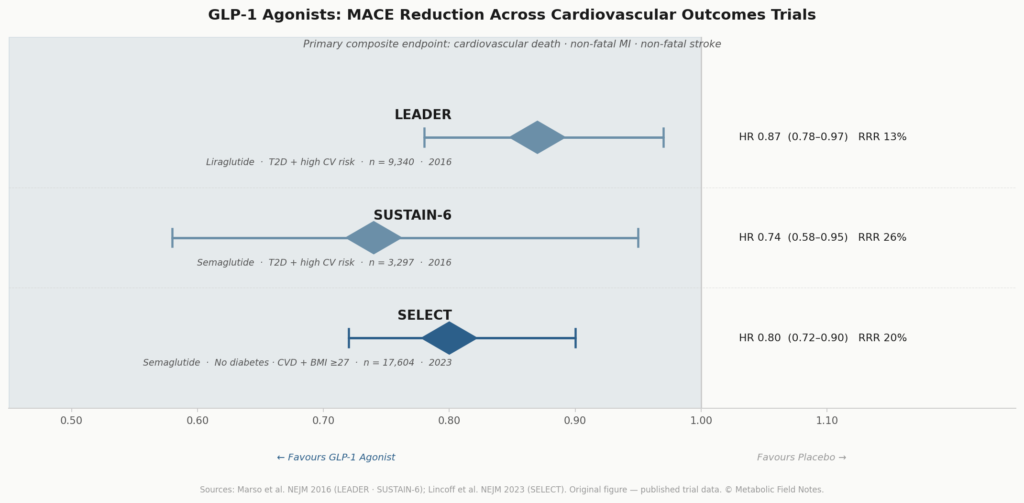
The LEADER trial (2016) enrolled 9,340 patients with type 2 diabetes and high cardiovascular risk, randomising them to liraglutide or placebo.[3] At a median follow-up of 3.8 years, liraglutide produced a 13% relative risk reduction in the primary composite of cardiovascular death, non-fatal myocardial infarction, and non-fatal stroke (HR 0.87, 95% CI 0.78-0.97). The SUSTAIN-6 trial (2016) enrolled 3,297 patients with type 2 diabetes and tested once-weekly semaglutide, demonstrating a 26% MACE reduction (HR 0.74, 95% CI 0.58-0.95).[4] Both trials enrolled populations with existing diabetes, leaving unresolved whether the cardiovascular signal was mediated through glycaemic improvement rather than direct GLP-1R activity.
The SELECT trial (2023) was designed to resolve this directly.[1] Participants had established atherosclerotic cardiovascular disease and a BMI >= 27, but no history of diabetes. Randomisation to semaglutide 2.4 mg once weekly produced a 20% MACE reduction at 3.3 years (HR 0.80, 95% CI 0.72-0.90). Glycaemic confounding was structurally excluded from the design. This is the first large-scale cardiovascular outcomes trial to demonstrate GLP-1R benefit in a non-diabetic population.
Several receptor-direct mechanisms are proposed. GLP-1R on cardiac myocytes appears to modulate post-ischaemic recovery and reduce infarct size in experimental models. Vascular endothelial GLP-1R activation reduces oxidative stress and promotes nitric oxide synthesis, both relevant to plaque stability. Anti-inflammatory effects on macrophages within vessel walls may reduce foam cell formation and slow atherogenesis. The precise weighting of each pathway relative to haemodynamic improvements from weight reduction is not resolved — but the SELECT trial makes the case for a receptor-direct cardiovascular component substantially stronger than it was before 2023.
One practical implication: cardiovascular risk reduction as an independent indication for GLP-1R agonist therapy is now under active guideline consideration, separate from diabetes management or weight loss treatment.
Renal Protection: The FLOW Trial and Direct Tubular Effects
GLP-1R expression in the renal proximal tubule was established before a dedicated outcomes trial demonstrated its clinical significance. At that location, receptor activation promotes natriuresis, reduces tubular oxidative stress, and — in rodent models — inhibits fibrosis signalling through TGF-beta suppression. Whether this translated to meaningful renal protection in humans required a trial built specifically to answer that question.
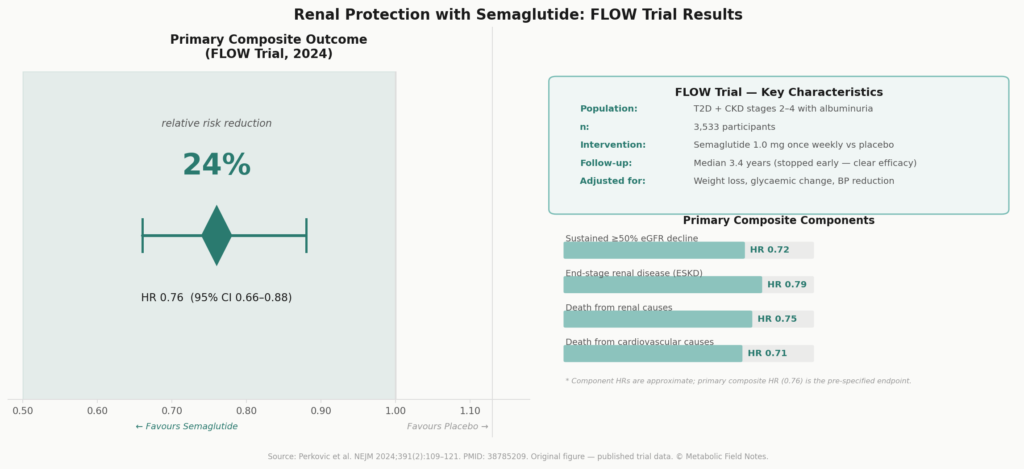
The FLOW trial (2024) enrolled 3,533 patients with type 2 diabetes and chronic kidney disease (stages 2-4 with elevated urinary albumin-to-creatinine ratio), randomising them to once-weekly semaglutide 1.0 mg or placebo.[5] The primary composite outcome — comprising a sustained 50% or greater decline in eGFR, end-stage renal disease, or death from renal or cardiovascular causes — was reduced by 24% in the semaglutide group (HR 0.76, 95% CI 0.66-0.88). The independent data monitoring committee stopped the trial early for clear efficacy.
Critically, the renal benefit persisted after statistical adjustment for achieved weight loss, glycaemic improvement, and systolic blood pressure reduction, supporting a receptor-direct component beyond haemodynamic mediation. SGLT-2 inhibitors had established a renal protection signal earlier through overlapping but distinct mechanisms — particularly via tubuloglomerular feedback modulation. FLOW positions semaglutide as complementary, not redundant. The combination of GLP-1R agonists and SGLT-2 inhibitors in CKD is an active area of clinical trial investigation, with mechanistic rationale for additive nephroprotection.
Hepatic Effects: GLP-1 Receptor Activity in MAFLD and MASH
Metabolic dysfunction-associated fatty liver disease (MAFLD) affects approximately 25% of the global adult population. Until recently, no pharmacological agent had regulatory approval for its treatment across the full severity spectrum. GLP-1R expression on hepatocytes and Kupffer cells provided the mechanistic basis for studying this class in that indication.
GLP-1R activation in hepatocytes promotes fatty acid oxidation and inhibits de novo lipogenesis through cAMP/PKA-mediated suppression of lipogenic transcription factors, including SREBP-1c. In Kupffer cells — the liver-resident macrophages — GLP-1R signalling suppresses pro-inflammatory cytokine release, including TNF-alpha and IL-1beta. This dual action operates partly independently of steatosis reduction, which is relevant because MASH progression is driven by both lipid accumulation and sustained hepatic inflammation.
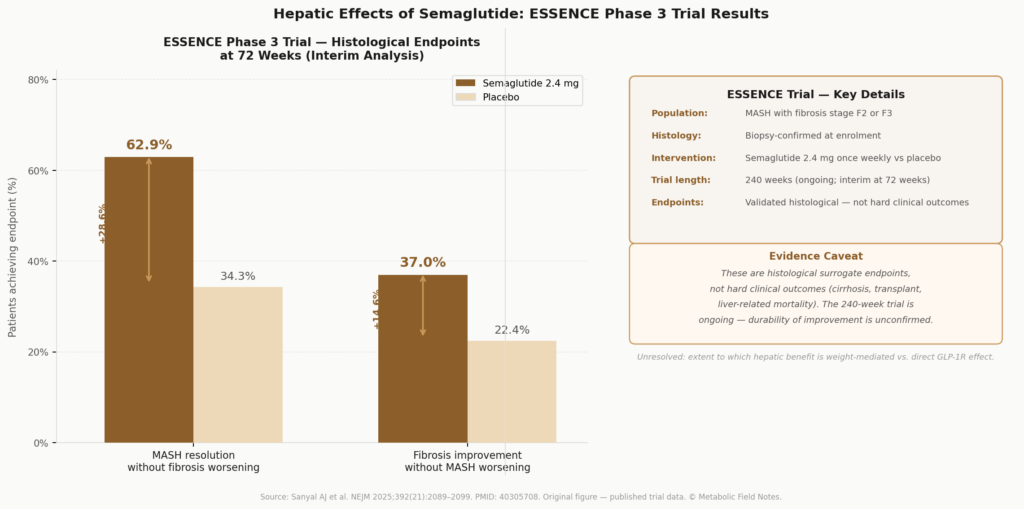
Phase 3 data for semaglutide 2.4 mg in metabolic dysfunction-associated steatohepatitis (MASH) are available from the ESSENCE trial.[6] Enrolled patients had histologically confirmed MASH with fibrosis stage F2 or F3. Semaglutide produced MASH resolution without worsening of fibrosis in 62.9% of participants compared to 34.3% in the placebo group. Fibrosis improvement without worsening of MASH activity was also significantly greater in the treatment arm. These are validated histological endpoints with clinical meaning — though they are not equivalent to hard outcomes such as cirrhosis progression or liver-related mortality. Additionally, these figures represent an interim analysis at 72 weeks of an ongoing 240-week trial; whether histological improvements are sustained at trial completion remains to be established.
One methodological caveat persists: caloric restriction producing comparable weight loss generates similar steatosis reduction in short-term studies, making it difficult to attribute hepatic improvement specifically to GLP-1R signalling rather than to the downstream metabolic effects of reduced adiposity. This question has not been definitively resolved in the clinical trial data.
Neurological and Anti-Inflammatory Mechanisms: Established Signals and Appropriate Limits
GLP-1R expression in the central nervous system is concentrated in the arcuate nucleus, hippocampus, ventral tegmental area, and nucleus accumbens — regions governing energy balance, memory consolidation, and reward processing, respectively. The implications of GLP-1 receptor activity in the brain extend beyond appetite suppression: in microglia, the brain-resident immune cells, GLP-1R activation suppresses NF-kB pathway activity and NLRP3 inflammasome signalling, reducing neuroinflammatory output in preclinical models.[7]
The clinical domain attracting the most current interest is addiction. Observational data and retrospective cohort analyses consistently report reduced alcohol consumption, higher smoking cessation rates, and potentially reduced opioid relapse in GLP-1R agonist users relative to matched controls.[8] The proposed mechanism — GLP-1R-mediated attenuation of dopaminergic reward circuitry in the nucleus accumbens — is well supported by preclinical rodent studies and connects to the same receptor pathways documented in research on how GLP-1s suppress food-oriented reward signals. Multiple prospective randomised trials are underway in alcohol use disorder and opioid use disorder, but no Phase 3 results with clinical endpoints have been published.
Data on cognitive protection follow a similar pattern. Observational analyses in large healthcare databases report lower rates of incident dementia in GLP-1R agonist users compared to controls on other glucose-lowering therapies. These signals are consistent across datasets and time points. They cannot be interpreted causally, however, given the confounding inherent in observational comparisons: users of GLP-1R agonists tend to be under closer medical supervision, more medication-adherent, and subject to more frequent metabolic monitoring than matched comparator populations.
What can be stated with appropriate precision: the mechanistic case for neurological and anti-inflammatory GLP-1R effects is biologically coherent and generates consistent signals in human observational data. The clinical outcomes evidence has not yet met the standard required for indication-specific prescribing in neurology or addiction medicine.
Evidence Grading Across Benefit Domains
A proportionate reading of the non-weight evidence base requires applying consistent evidentiary standards across domains.
The cardiovascular and renal benefit signals are supported by large, pre-registered RCTs with prospective, adjudicated primary outcomes. SELECT and FLOW are high-quality trials with sufficient power, defined endpoints, and appropriate follow-up duration. These signals should be treated as established for clinical decision-making purposes.
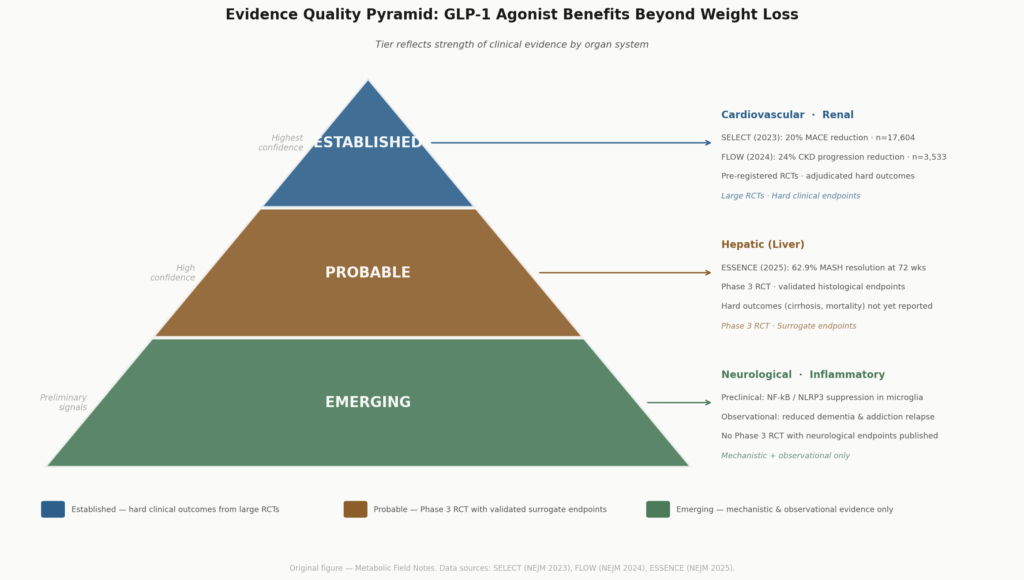
The hepatic benefit signal is supported by Phase 3 trial data with validated histological endpoints — meaningful and actionable, though one tier below hard clinical outcomes such as cirrhosis incidence or transplant-free survival. The question of weight-mediated versus receptor-direct hepatocyte effect remains methodologically open. Hepatic benefit is probable and clinically applicable; it warrants the same epistemic qualifier that applies to any intervention where surrogate endpoints have been used.
The neurological and inflammatory signals are supported by mechanistic plausibility, consistent animal model data, and suggestive observational evidence in humans. They are not yet supported by prospective RCTs with pre-specified neurological or addiction endpoints. This domain warrants continued investigation and careful monitoring as trials report, not current clinical application beyond the studied indications.
GLP-1R agonists have accumulated a genuine multi-organ evidence base that extends well beyond their origin as glucose-lowering agents. The appropriate clinical posture is not to treat all benefit signals with identical confidence, but neither to dismiss the preliminary ones. Evidence matures at different rates across organ systems. Tracking that maturation — at the level of trial design and endpoint quality rather than headline claims — is what calibrated prescribing actually requires.
Join the Field Notes
Metabolic Field Notes tracks the evidence as it develops, without protocol-pushing and without hype. If evidence-aware, translational science is useful to you, join the Field Notes.
REFERENCES
[1] Lincoff AM, Brown-Frandsen K, Colhoun HM, et al. Semaglutide and Cardiovascular Outcomes in Obesity without Diabetes. N Engl J Med. 2023;389(24):2221-2232. DOI: 10.1056/NEJMoa2307563. PMID: 37952131
[2] Drucker DJ. Mechanisms of Action and Therapeutic Application of Glucagon-like Peptide-1. Cell Metab. 2018;27(4):740-756. DOI: 10.1016/j.cmet.2018.03.001. PMID: 29617641
[3] Marso SP, Daniels GH, Brown-Frandsen K, et al. Liraglutide and Cardiovascular Outcomes in Type 2 Diabetes. N Engl J Med. 2016;375(4):311-322. DOI: 10.1056/NEJMoa1603827. PMID: 27295427
[4] Marso SP, Bain SC, Consoli A, et al. Semaglutide and Cardiovascular Outcomes in Patients with Type 2 Diabetes. N Engl J Med. 2016;375(19):1834-1844. DOI: 10.1056/NEJMoa1607141. PMID: 27633186
[5] Perkovic V, Tuttle KR, Rossing P, et al. Semaglutide in Patients with Type 2 Diabetes and Chronic Kidney Disease. N Engl J Med. 2024;391(2):109-121. DOI: 10.1056/NEJMoa2403347. PMID: 38785209
[6] Sanyal AJ, Newsome PN, Kliers I, et al. Phase 3 Trial of Semaglutide in Metabolic Dysfunction-Associated Steatohepatitis. N Engl J Med. 2025;392(21):2089-2099. DOI: 10.1056/NEJMoa2413258. PMID: 40305708
[7] Review: GLP-1 receptor agonists, neuroinflammation, and addiction. PMID: 40843757
[8] Klausen MK, Thomsen M, Wortwein G, et al. The Role of Glucagon-Like Peptide 1 (GLP-1) in Addictive Disorders. Br J Pharmacol. 2022;179(4):625-641. DOI: 10.1111/bph.15777
Medical Disclaimer: The content on this blog is for informational and educational purposes only and does not constitute professional medical advice, diagnosis, or treatment. Always seek the advice of your physician or other qualified health provider with any questions you may have regarding a medical condition.


Pingback: Fatty Liver Disease Burden in India: The Hidden Scale
Pingback: India's Hidden Sleep Crisis: Why 104 Million Cases Stay Hidden
Pingback: OSA and GLP-1 Drugs: What the SURMOUNT-OSA Trial Actually Showed -
Pingback: GLP-1 Receptor Agonists Beyond Obesity: Evidence Review
Pingback: GLP-1 Eye Monitoring: Guide for People With Diabetes