

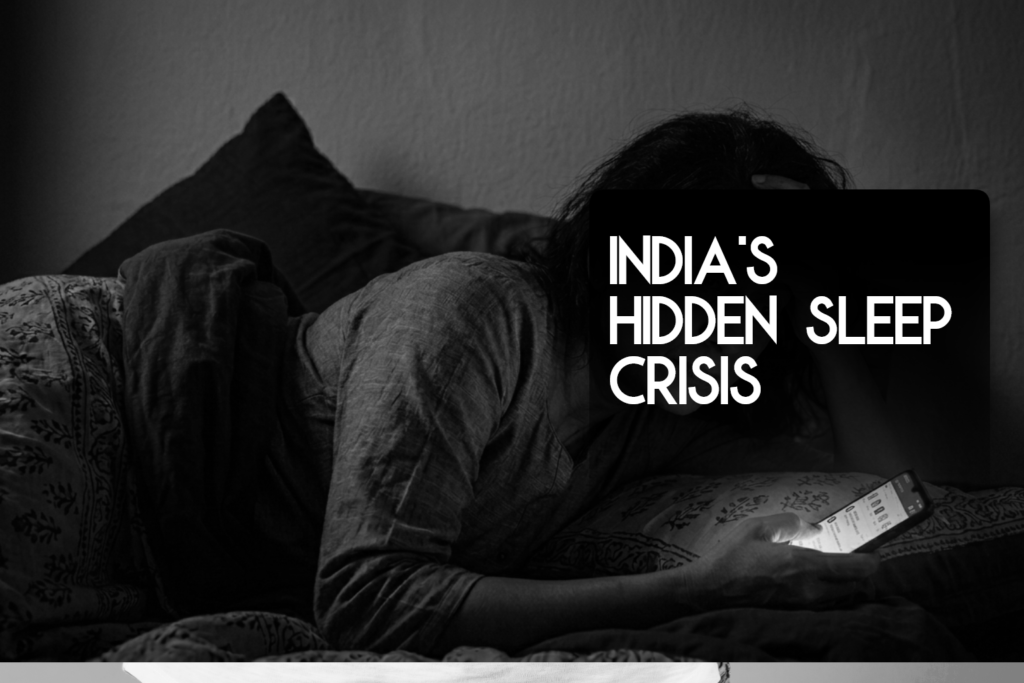
Part 1 of the OSA Trilogy
Something keeps appearing in the data that doesn’t match what I see discussed in Indian health circles. A 2023 systematic review pulled together 8 studies covering 11,009 Indian adults and arrived at a figure that, if accurate, puts obstructive sleep apnea among the largest unaddressed health burdens in the country.
The number is 104 million.
That is the estimated count of working-age Indians living with obstructive sleep apnea — a condition in which the airway collapses repeatedly during sleep, triggering oxygen drops and stress hormone surges, sometimes hundreds of times a night. Of those 104 million, the same analysis estimates that 47 million have moderate-to-severe disease. Almost none of them know.
What struck me about this figure isn’t just its size. It’s how quietly it sits.
A number worth pausing on
The 2023 meta-analysis by Suri and colleagues, published in Sleep Medicine Reviews, represents the most comprehensive look at OSA prevalence in the Indian adult population to date.[1] Eight studies. 11,009 subjects. Mean ages ranging from 35.5 to 47.8 years. The pooled prevalence of OSA — defined by an Apnea-Hypopnea Index (AHI) of 5 or more events per hour — was 11% overall. In males, it climbed to 13%. In females, 5%.
These are polysomnography-based numbers. Not questionnaire estimates. Sleep studies.
At 11% prevalence across a working-age population of roughly 950 million, the arithmetic produces the 104 million figure. Moderate-to-severe OSA — AHI of 15 or more events per hour — was found in 5% of those studied, yielding the 47 million estimate.
For context: India’s total diagnosed cancer burden is estimated at around 1.4 million new cases per year. The number of Indians likely living with undiagnosed moderate-to-severe sleep apnea right now is 33 times that.
The heterogeneity across included studies was high (I-squared up to 98%), which tells us that regional variation is real and the 11% figure is a pooled estimate, not a fixed truth. But even if the real number is half that — even at 5% prevalence — we are still talking about 47 million people with a condition that goes largely undetected.
At a weight that shouldn’t matter
Here is the thing that makes this particularly difficult to see coming: OSA in Indian adults does not look like OSA in the literature most clinicians trained on.
The classic Western profile is a large-necked, high-BMI male with loud snoring and excessive daytime sleepiness. That profile has shaped screening tools, clinical intuitions, and patient expectations worldwide. In India, the picture is different — and that difference is part of why the 104 million figure stays where it is.
Indian adults develop OSA at BMIs that wouldn’t flag concern in a standard consultation. The reasons are anatomical and metabolic. Craniofacial structures in South Asian populations tend toward a smaller pharyngeal airway — shorter mandibles, more posterior jaw positioning, less room for the tongue when muscles relax during sleep. This is not a pathology. It is a population-level anatomical pattern. But it means the airway margin is thinner before any weight-related factor adds pressure.
The second driver is the “thin-fat Indian” phenotype — a pattern well-documented in metabolic research where visceral adiposity accumulates at BMIs that a clinician would not associate with obesity.[2] The same visceral fat pattern that drives fatty liver disease is also what narrows the pharyngeal space , two conditions, one upstream driver. (See: GLP-1 and fatty liver: the shared metabolic root) Fat around the neck, the tongue base, and the upper airway walls narrows the pharyngeal space without any of the external signals that typically prompt a sleep disorder referral.
The combination — narrower baseline airway plus visceral fat at lower bodyweight — means that BMI is a poor screening threshold in this population. A person at a BMI of 24 may carry the same OSA risk as a Western patient at BMI 30. That gap in calibration is where millions of diagnoses disappear.
The architecture of invisibility
The Suri review’s headline figure tells you the scale. It doesn’t tell you why more than 90% of those 104 million remain undiagnosed. That requires a different kind of accounting.
Sleep labs capable of conducting polysomnography — the gold-standard diagnostic test — are concentrated in major metros. Tier-2 and tier-3 cities have almost none. A sleep study costs between Rs. 8,000 and Rs. 25,000 out of pocket and is rarely covered by insurance. For most of the country, it is simply not a test that gets ordered.
Then there is the symptom attribution problem. The presenting features of OSA — persistent daytime fatigue, morning headaches, difficulty concentrating, irritability, low mood — are common enough to map onto a dozen other diagnoses. In the Indian clinical context, these symptoms are typically investigated first as anemia, hypothyroidism, diabetes-related fatigue, or burnout. Sleep apnea doesn’t reach the differential until others have been ruled out. Which often means it doesn’t reach the differential at all.
And underneath all of it, snoring is culturally normalized in ways that actively suppress early detection. It is read as a sign of deep, satisfying sleep. The partner who notices it may not report it. The individual who experiences it rarely frames it as a symptom.
The architecture of invisibility is not one thing. It is structural, economic, clinical, and cultural — and each layer reinforces the others.
What stays in the throat doesn’t stay in the throat
The Suri review noted something beyond the prevalence numbers: OSA in Indian adults was associated with diabetes, hypertension, and metabolic syndrome across the included studies.[1]
This is not coincidental overlap. Each apnea event — each moment the airway closes and oxygen drops — triggers a stress response. Cortisol rises. Catecholamines surge. Blood pressure spikes briefly, returns, then spikes again. Across an 8-hour sleep window, a person with moderate-to-severe OSA may experience this cycle 120 to 240 times.
The metabolic cost of that nightly pattern compounds over years. Chronic intermittent hypoxia impairs insulin sensitivity through oxidative stress pathways. Repeated sympathetic activation raises 24-hour blood pressure baselines. Fragmented sleep disrupts leptin and ghrelin regulation, driving appetite toward energy-dense foods and away from satiety signals.
What looks like a breathing problem at night shows up as hypertension at the morning clinic visit, as HbA1c creep in the quarterly diabetes review, as abdominal weight that resists every intervention attempted in isolation. These are the same cardiometabolic pathways where GLP-1 therapy has shown cardiometabolic benefits beyond weight loss — a connection we return to in Part 3.
The 47 million with moderate-to-severe, undiagnosed OSA are not just sleeping badly. They are running a nightly metabolic stress test with no recovery period.
The pattern this data is pointing toward
The 104 million figure matters precisely because it is large enough to indicate a systemic problem, not a rare one. OSA in Indian adults is, in the data, a prevalent and largely invisible contributor to the country’s cardiometabolic disease burden.
What the data doesn’t yet fully answer is the causal chain running from undiagnosed OSA outward into metabolic dysfunction — and whether treating it changes the trajectory. That is the question at the center of Parts 2 and 3 of this series.
Part 2 traces the OSA-metabolic disease loop more closely: what repeated hypoxic stress does to insulin signalling, adipose tissue behavior, and inflammatory markers. Part 3 examines what the SURMOUNT-OSA trial data showed about tirzepatide — and what it suggests about where treatment protocols may be heading.
If you are following this series, Field Notes is where the data lands first.
Join the Field Notes
Metabolic Field Notes tracks the evidence as it develops, without protocol-pushing and without hype. If evidence-aware, translational science is useful to you, join the Field Notes.
Medical Disclaimer: The content on this blog is for informational and educational purposes only and does not constitute professional medical advice, diagnosis, or treatment. Always seek the advice of your physician or other qualified health provider with any questions you may have regarding a medical condition.
REFERENCES
[1] Suri TM, Ghosh T, Mittal S, Hadda V, Madan K, Mohan A. Systematic review and meta-analysis of the prevalence of obstructive sleep apnea in Indian adults. Sleep Med Rev. 2023;71:101829. PMID: 37517357. DOI: 10.1016/j.smrv.2023.101829
[CITE: PubMed search inconclusive for craniofacial-OSA anatomy in Indian/South Asian patients. Recommend Dr. Bishnu provide preferred reference — likely from Indian sleep medicine or ENT literature, e.g., Sharma SK et al. or a cephalometric study from AIIMS. This claim needs a citation before publishing.]
[2] Yajnik CS. Early life origins of insulin resistance and type 2 diabetes in India and other Asian countries. J Nutr. 2004;134(1):205-10. PMID: 14704320. DOI: 10.1093/jn/134.1.205