


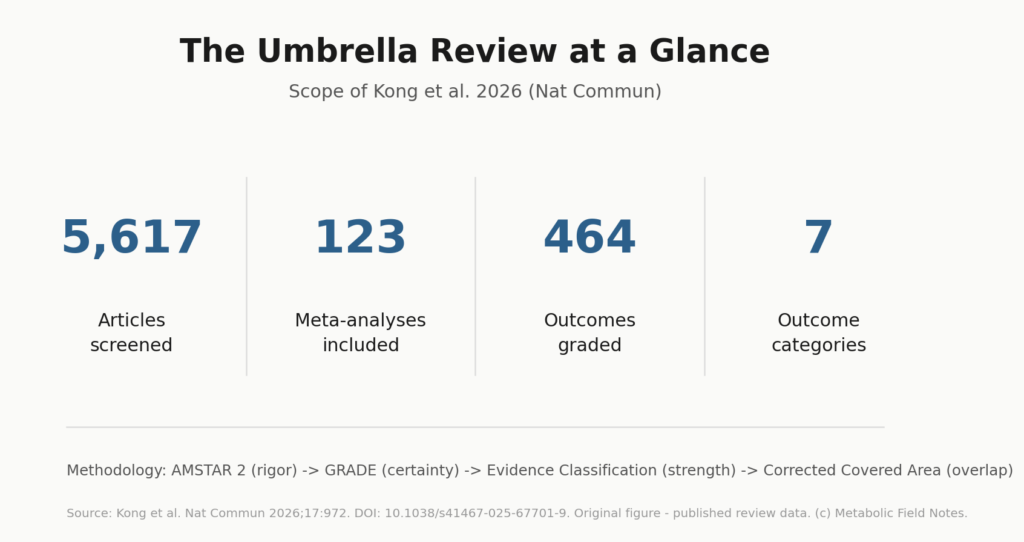
Across 123 meta-analyses and 464 distinct outcomes, the evidence base for GLP-1 receptor agonists extends well past the metabolic and weight-related indications most readers already associate with the drug class. Some of that evidence carries relatively strong certainty grading. A meaningful share does not, and the distinction matters more than any single headline benefit.
A 2026 umbrella review published in Nature Communications by Kong and colleagues screened 5,617 articles and consolidated 123 existing meta-analyses spanning seven outcome categories: endocrine and metabolic, cardiovascular, cancer, renal, respiratory, mortality and adverse events, and a residual “other” category covering cognitive and miscellaneous endpoints [1]. Rather than generating new clinical data, the review applies a standardized quality framework to findings that already exist. The result is less a benefits list than a map of where confidence is earned and where it may be inflated by overlapping evidence.
An umbrella review, not a single trial
An umbrella review sits one level above a meta-analysis. Where a meta-analysis pools individual studies, an umbrella review evaluates multiple meta-analyses and assesses the strength, consistency, and methodological quality of those evidence syntheses. That distinction shapes how its conclusions should be read.
The authors applied three main evaluative instruments across the included meta-analyses. AMSTAR 2 assesses methodological rigor, including protocol registration, search comprehensiveness, and risk-of-bias handling. GRADE assigns certainty ratings to pooled outcomes, ranging from High to Very Low, based on issues such as consistency, precision, and risk of bias. Evidence Classification then sorts associations into Class I through IV, or Not Significant, according to strength-of-association criteria.
A fourth metric, Corrected Covered Area (CCA), measures something different: how much the primary studies feeding into different meta-analyses overlap with one another. A category can show many independent-looking meta-analyses while repeatedly drawing on the same limited set of pivotal trials. CCA helps distinguish convergent evidence from the same evidence wearing different statistical clothing. Values run from slight overlap at 5% or below to very high overlap above 15%.
Cardiovascular and metabolic outcomes sit on the firmest ground
The endocrine and metabolic category is, unsurprisingly, where GLP-1 receptor agonists have the deepest evidence base. Glycemic control, body weight, and lipid parameters are supported by a large body of randomized clinical trial evidence accumulated across the drug class. In the umbrella review, many endocrine and metabolic outcomes show favorable associations, although certainty still varies by endpoint, population, and underlying study design [1]. Liver enzyme outcomes — including markers relevant to metabolic dysfunction-associated steatotic liver disease — also appear in this category, with favorable associations noted in several pooled analyses, though the evidence base for those specific endpoints is covered in more depth elsewhere.
Cardiovascular outcomes are also among the better-supported categories, but the certainty is not uniform across every endpoint. Major adverse cardiovascular events, or MACE, usually refers to a composite of cardiovascular death, nonfatal myocardial infarction, and nonfatal stroke. Several large cardiovascular outcome trials, initially required to establish cardiovascular safety in diabetes populations, have shown cardiovascular benefit for selected GLP-1 receptor agonists in patients with established cardiovascular disease or high cardiovascular risk.
The SELECT trial extended this evidence to adults with overweight or obesity and established cardiovascular disease, but without diabetes, reporting a reduction in the composite of cardiovascular death, nonfatal myocardial infarction, and nonfatal stroke over multi-year follow-up [3]. This is important because it separates at least part of the cardiovascular signal from glucose lowering alone.
What the umbrella review adds is not new trial data but a certainty audit of how the evidence holds together across multiple meta-analyses. Its cardiovascular findings range across classification and certainty tiers rather than forming a single uniform “high-certainty” block. That matters: MACE and cardiovascular mortality are better grounded than many exploratory organ-system signals, but heart failure hospitalization and several secondary endpoints remain more mixed or imprecise [1].
Several plausible mechanisms have been proposed for cardiovascular benefit, including weight reduction, modest blood pressure lowering, lipid changes, anti-inflammatory effects, and endothelial effects. Their relative contribution remains uncertain, and clinical outcome data should not be reduced to any single mechanistic explanation.
Renal, respiratory, cancer, and less-discussed categories
Renal outcomes occupy an unusual position: the directional signal is clinically important, but the evidence is concentrated in fewer source trials than the cardiovascular category. Pooled analyses consistently report favorable movement in albuminuria and kidney-function-related outcomes in patients with type 2 diabetes and chronic kidney disease. This direction of evidence is reinforced by the FLOW trial, a dedicated renal outcomes trial of semaglutide in patients with type 2 diabetes and chronic kidney disease [2].
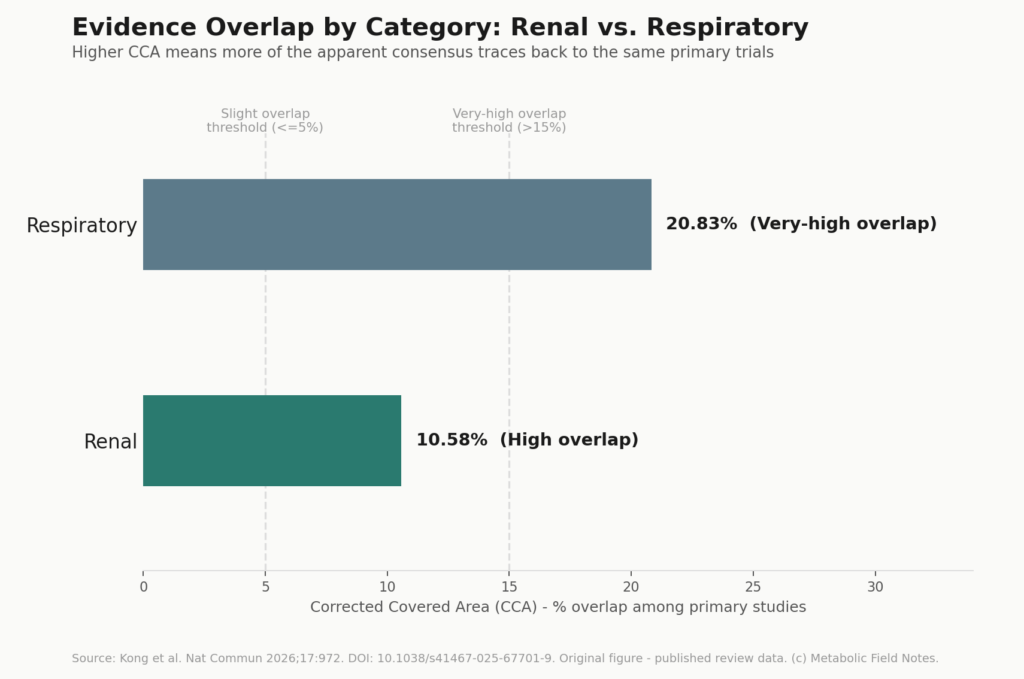
The umbrella review’s renal category had a CCA value of 10.58%, classified as high overlap [1]. In practice, that means the apparent volume of renal evidence partly reflects repeated use of the same underlying studies across multiple meta-analyses. The renal signal should be taken seriously, but the number of meta-analyses should not be mistaken for the number of genuinely independent datasets.
Respiratory outcomes show the highest overlap of any category in the review, with a CCA value of 20.83%, the very-high-overlap tier [1]. Findings in this category include signals around pneumonia and COVID-19-related outcomes, both biologically plausible given the links among obesity, inflammation, and respiratory mechanics. But very high overlap means the apparent literature volume may overstate the amount of independent evidence supporting these claims.
Cancer outcomes remain unsettled. The most cautious reading is not that GLP-1 receptor agonists prevent cancer, but that current evidence is heterogeneous and mostly not ready for clinical inference. The umbrella review found many cancer outcomes to be Not Significant, with isolated signals that require careful interpretation rather than translation into patient expectations [1].
The “other” category, including cognitive function and dementia-related endpoints, carries thinner and more heterogeneous evidence. Early signals are worth watching, but the umbrella review treats much of this area as exploratory rather than established. That is the correct posture for findings that are recent, methodologically diverse, and not yet anchored by dedicated outcome trials.
Adverse events and where the evidence strains
Gastrointestinal adverse events, including nausea, vomiting, diarrhea, and constipation, remain the best-characterized safety signals in the GLP-1 receptor agonist literature. These effects are common, dose-related, and are a major reason for treatment discontinuation in clinical practice and trials.
Several less common signals carry more interpretive weight than their frequency alone would suggest. Diabetic ketoacidosis risk is especially relevant when GLP-1 receptor agonists are used off-label in type 1 diabetes or in settings where insulin is reduced inappropriately. Gallbladder disease, including cholelithiasis and cholecystitis, shows a modest risk signal, likely influenced by weight loss and possibly by effects on gastrointestinal and biliary motility.
Pancreatitis remains a contested safety topic. Pharmacovigilance and observational datasets have at times reported elevated signals, while randomized trial meta-analyses have often failed to show a statistically significant increase. Because the draft citation for a specific 2025 VA-based pancreatitis analysis could not be verified, that specific claim has been removed from this publication-ready version. The safer statement is that pancreatitis should be treated as an unresolved surveillance signal rather than a settled class-wide causal effect.
Suicidality has followed a similar interpretive pattern. Disproportionality signals in spontaneous reporting systems have led regulators to continue monitoring, but randomized trial pools have not consistently confirmed a causal association. This is a case where seriousness of outcome justifies surveillance even when causality remains unproven.
Where overlap concentrates: reading certainty correctly
The categories most likely to be cited confidently in casual conversation about this drug class, respiratory and renal outcomes, are also categories where the umbrella review’s own overlap metric counsels caution. A very-high CCA value in respiratory outcomes and a high CCA value in renal outcomes mean that a relatively small number of primary studies may be doing a large share of the evidentiary work.
This is not a flaw unique to GLP-1 receptor agonist research. It is a structural feature of any drug class evaluated through dozens of overlapping systematic reviews drawing on the same pivotal trials. But it does mean that a reader encountering a claim like “GLP-1 drugs reduce pneumonia risk” should ask a follow-up question: how many genuinely separate datasets support that claim, and how generalizable are they?
It is also worth stating plainly that most organ-system findings described in an umbrella review are research associations, not approved clinical indications. Regulatory approval remains indication- and molecule-specific. GLP-1-based therapies are approved for type 2 diabetes and chronic weight management, and selected agents have additional indications such as cardiovascular-risk reduction, kidney-risk reduction in adults with type 2 diabetes and chronic kidney disease, or obstructive sleep apnea in adults with obesity [4–6]. Tirzepatide should be described as a dual GIP/GLP-1 receptor agonist rather than a pure GLP-1 receptor agonist.
A favorable signal in an umbrella review is evidence worth tracking, not a basis for off-label prescribing decisions. The smaller and more overlapping the evidence base behind a category, the more that distinction matters.
What this means for clinical decision-making
The practical takeaway from this review is not that GLP-1 receptor agonists have a long list of benefits. That framing already exists elsewhere and tends to flatten categories of very different evidentiary strength into one undifferentiated claim. The more useful takeaway is a method: when evaluating a claim about this drug class, ask which organ system, what certainty grade, what population, and how much independent data supports it.
Cardiovascular and metabolic outcomes currently sit on the firmest ground, reinforced by dedicated outcome trials designed to test those endpoints. Renal outcomes are increasingly important and supported by dedicated trial evidence in type 2 diabetes with chronic kidney disease, but the umbrella review’s high overlap metric still argues against over-reading the number of meta-analyses. Respiratory, cancer, and cognitive outcomes remain provisional, supported by signals worth continued research attention rather than findings ready to anchor clinical practice or patient expectations.
The umbrella review’s most useful contribution is not a new finding about any single organ system. It is a working demonstration that “the evidence supports X” is an incomplete sentence until it specifies the grading tier, the patient population, and the independence of the underlying evidence. A category with twenty meta-analyses and a very-high CCA value is not necessarily better supported than a category with three meta-analyses and a low CCA value. Volume of literature and independence of evidence are different things.
As dedicated outcome trials for renal, respiratory, and cognitive endpoints mature, several categories currently graded as Low or Moderate certainty may either firm up with independent confirmation or be revised downward once overlap-driven false confidence is corrected. The categories worth watching most closely are the ones where CCA is highest, because that is where a single new large trial, positive or negative, can move the certainty grade most.
Join the Field Notes
Metabolic Field Notes tracks the evidence as it develops, without protocol-pushing and without hype. If evidence-aware, translational science is useful to you, join the Field Notes.
REFERENCES
[1] Kong F, Zhao Y, Zhang W, Wang X, Wu T, Zhou Z, Xu Y, Xia L, Sun T. Comprehensive evaluation of GLP-1 receptor agonists: an umbrella review of clinical outcomes across multiple diseases. Nat Commun. 2026;17:972. DOI: 10.1038/s41467-025-67701-9
[2] Perkovic V, Tuttle KR, Rossing P, et al. Effects of Semaglutide on Chronic Kidney Disease in Patients with Type 2 Diabetes. N Engl J Med. 2024;391:109-121. DOI: 10.1056/NEJMoa2403347
[3] Lincoff AM, Brown-Frandsen K, Colhoun HM, et al. Semaglutide and Cardiovascular Outcomes in Obesity without Diabetes. N Engl J Med. 2023;389:2221-2232. DOI: 10.1056/NEJMoa2307563
[4] U.S. Food and Drug Administration. FDA approves first treatment to reduce risk of serious heart problems specifically in adults with obesity or overweight. March 8, 2024.
[5] Novo Nordisk. FDA approves Ozempic (semaglutide) to reduce the risk of worsening kidney disease and cardiovascular death in adults with type 2 diabetes and chronic kidney disease. January 28, 2025.
[6] U.S. Food and Drug Administration. FDA approves first medication for obstructive sleep apnea. December 20, 2024.