

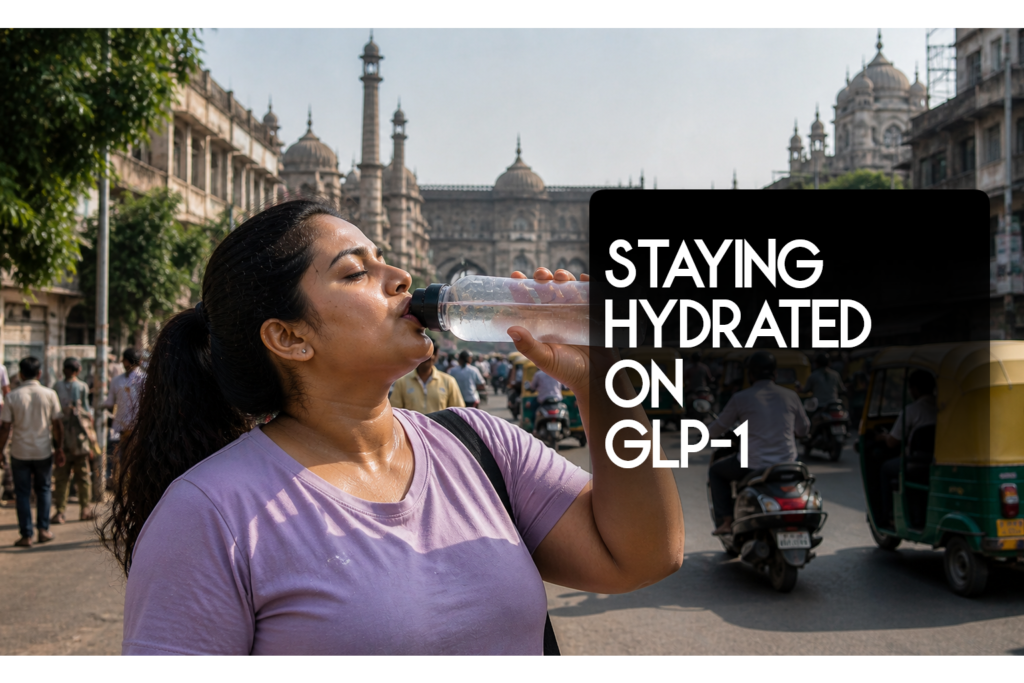
The Thirst Trap: Staying Hydrated on GLP-1 Medication This Summer
You’re probably drinking less water than you think. And the unsettling part is that your body won’t alert you – not with the usual thirst, not the way it used to.
If you’ve been on semaglutide or tirzepatide and found that summer is hitting harder than expected: more fatigue, more headaches, legs cramping in the heat – hydration is worth examining before you attribute all of it to the medication. Not because you’ve been careless, but because the drug has quietly changed one of your body’s most fundamental intake signals.
Staying hydrated on GLP-1 medication is harder than most patients expect. And the reason has nothing to do with forgetting.
Your body’s thirst alarm is quieter than usual
GLP-1 receptors are expressed in the hypothalamus, the part of your brain that manages both hunger and thirst through closely overlapping pathways. When your medication dampens hunger signals, it’s working through this same circuitry. And that circuitry doesn’t cleanly separate the two.
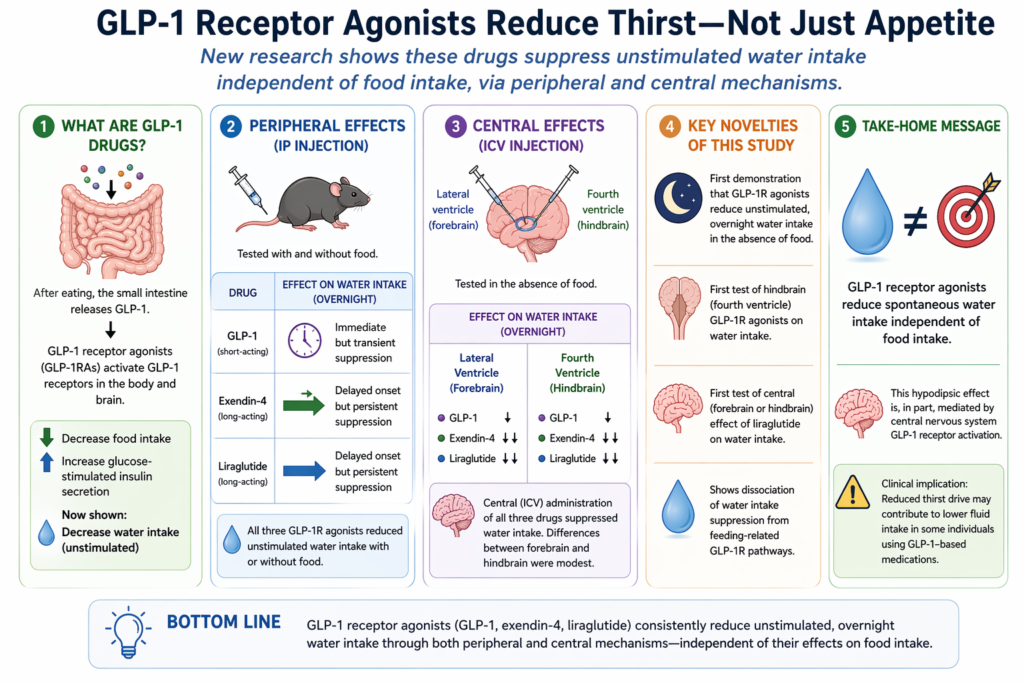
Research has confirmed that GLP-1 receptor agonists reduce water intake independently of their effects on food intake.[1] That’s an important distinction: your fluid consumption can drop even when you’re eating relatively normally, because the signal prompting you to drink has been turned down alongside the one driving hunger.
This is part of the same mechanism that drives broader neurological adaptations on GLP-1 therapy, including why stopping the medication affects appetite and brain signalling so quickly. Summer makes the fluid gap more pressing. Heat increases losses through sweat, but your internal prompt to drink stays muted. Nausea or loose stools, both common during dose escalation, accelerate losses further while making drinking feel unappealing at the same time.
The answer isn’t to try harder to remember. It’s to stop relying on thirst as your primary cue.
When dehydration wears a disguise
Here’s what catches most people out. The early signs of dehydration on GLP-1 medication – fatigue, headaches, brain fog, leg cramps – look nearly identical to side effects of the medication itself. Afternoon tiredness gets attributed to the reduced calories. Headaches get assigned to the medication adjusting your system. Leg cramps get blamed on the weight loss. Each symptom already has an obvious nearby explanation, so the obvious explanation gets the credit.
This pattern of symptoms being misread and pinned on the medication rather than their real cause is something GLP-1 users encounter in other areas too: hair thinning during rapid weight loss follows the same attribution confusion. Knowing to question the default explanation is half the diagnostic work.
A useful check that doesn’t require guesswork: urine colour. Pale straw yellow means you’re reasonably hydrated. Dark yellow or amber means you’ve drifted, regardless of whether you felt thirsty. If you’re going to the bathroom fewer than four times a day, that’s another clear signal worth responding to. Your medication doesn’t change urine colour. Insufficient fluid does.
A summer protocol that doesn’t rely on thirst
The goal is to make drinking a timed habit rather than a felt need.
A practical starting point: roughly 250ml (about one cup) per waking hour. A phone reminder works well here; there’s nothing wrong with scaffolding a system around a signal that’s been pharmacologically quieted. In hot weather or after a nausea episode, swap one or two of those glasses for a drink with an electrolyte sachet. You’re replacing sodium and potassium alongside fluid, and both are lost through sweat and GI events, and both affect how your energy and muscles feel.
Check your urine mid-morning and again mid-afternoon. Pale straw yellow is the target. If it’s darker, drink another glass before moving on.
That’s the whole protocol. The mechanism is complicated. The response doesn’t need to be.
Dehydration during GLP-1 therapy isn’t a willpower issue or a habit failure. It’s the predictable outcome of a medication that turns down two of the body’s oldest intake signals at once. When you understand that the thirst alarm is pharmacologically quieted – not broken, just running at lower volume – you can stop blaming yourself for running dry and build a simple system instead.
Staying hydrated on GLP-1 medication this summer is one of the smallest adjustments available with some of the clearest payoff. Fatigue that felt like an unavoidable side effect often turns out to be something a glass of water resolves.
Join the Field Notes
Metabolic Field Notes tracks the evidence as it develops, without protocol-pushing and without hype. If evidence-aware, translational science is useful to you, join the Field Notes.
Practical weekly insights for navigating GLP-1 therapy, without the noise. Join the Field Notes.
References
[1] Hayes MR, et al. Glucagon-like peptide-1 receptor agonists suppress water intake independent of effects on food intake. American Journal of Physiology – Regulatory, Integrative and Comparative Physiology. 2011. PMCID: PMC3233845.
Medical Disclaimer: The content on this blog is for informational and educational purposes only and does not constitute professional medical advice, diagnosis, or treatment. Always seek the advice of your physician or other qualified health provider with any questions you may have regarding a medical condition.