

GLP-1 and Fatty Liver Disease: What the Trial Data Keeps Showing Beyond Weight Loss
Something keeps appearing in GLP-1 trial data that the weight-loss narrative tends to overlook. Livers are improving in patients who haven’t moved the scale as much as expected, and the degree of improvement doesn’t always track with how much weight they’ve lost.
This pattern is worth examining carefully.
Nonalcoholic fatty liver disease, now reclassified as metabolic dysfunction-associated steatotic liver disease (MASLD), affects roughly one in four adults worldwide. The standard framing is tidy: lose weight, reduce liver fat, reduce inflammation. GLP-1 agonists fit that story well as effective tools for metabolic weight reduction. But GLP-1 and fatty liver disease have a more direct relationship than the weight-loss chain suggests, and the mechanism appears to run deeper than a downstream effect of shrinking adipose tissue.
The finding that keeps appearing in the data
In weight-loss intervention trials, there is a rough expectation: liver fat reduction correlates with total body weight lost. A 5-10% reduction in body weight reliably improves liver histology. The arithmetic is consistent enough that clinicians use it as a benchmark.
What struck me about the early semaglutide NAFLD data was a mismatch. NASH resolution rates that exceeded what the weight-loss arithmetic alone would predict. This is part of a broader signal: GLP-1 appears to reach systems that caloric restriction alone cannot fully access.
A Phase 2 trial published in the New England Journal of Medicine in 2021 enrolled 320 patients with biopsy-confirmed NASH and randomised them to semaglutide or placebo over 72 weeks. Participants in the treatment arm lost roughly 12-13% of body weight. Substantial, but not exceptional for intensive lifestyle intervention. Yet 59% achieved NASH resolution without worsening of fibrosis, compared to 17% in the placebo group.[1]
Diet-only trials achieving similar weight loss typically show NASH resolution in the 25-35% range. The gap between those benchmarks and the semaglutide result suggests the drug is doing something the caloric deficit alone is not.
The liver has its own reception desk for this drug
GLP-1 receptors (GLP-1R) are expressed in human hepatocytes, though at lower density than in pancreatic beta cells. The extent of direct hepatic receptor activity versus indirect metabolic effects remains an active area of research, and the mechanisms are not fully separated in current human trial data. The pattern of GLP-1 acting on receptors across unexpected tissue types, whether in gut, brain, or now liver, is something we’ve tracked across several pieces in this series.
When GLP-1 receptor signaling reaches liver tissue, whether through direct hepatocyte receptor activation, vagal afferent signaling, or improved systemic insulin sensitivity, several relevant changes follow. De novo lipogenesis, the liver’s internal fat-production pathway, slows. Hepatic oxidative stress decreases. Inflammatory signalling involving TNF-alpha and IL-6 is attenuated.
These are not simply effects of fat leaving adipose tissue. They are hepatic responses to a drug that metabolic tissues appear to receive and act on.
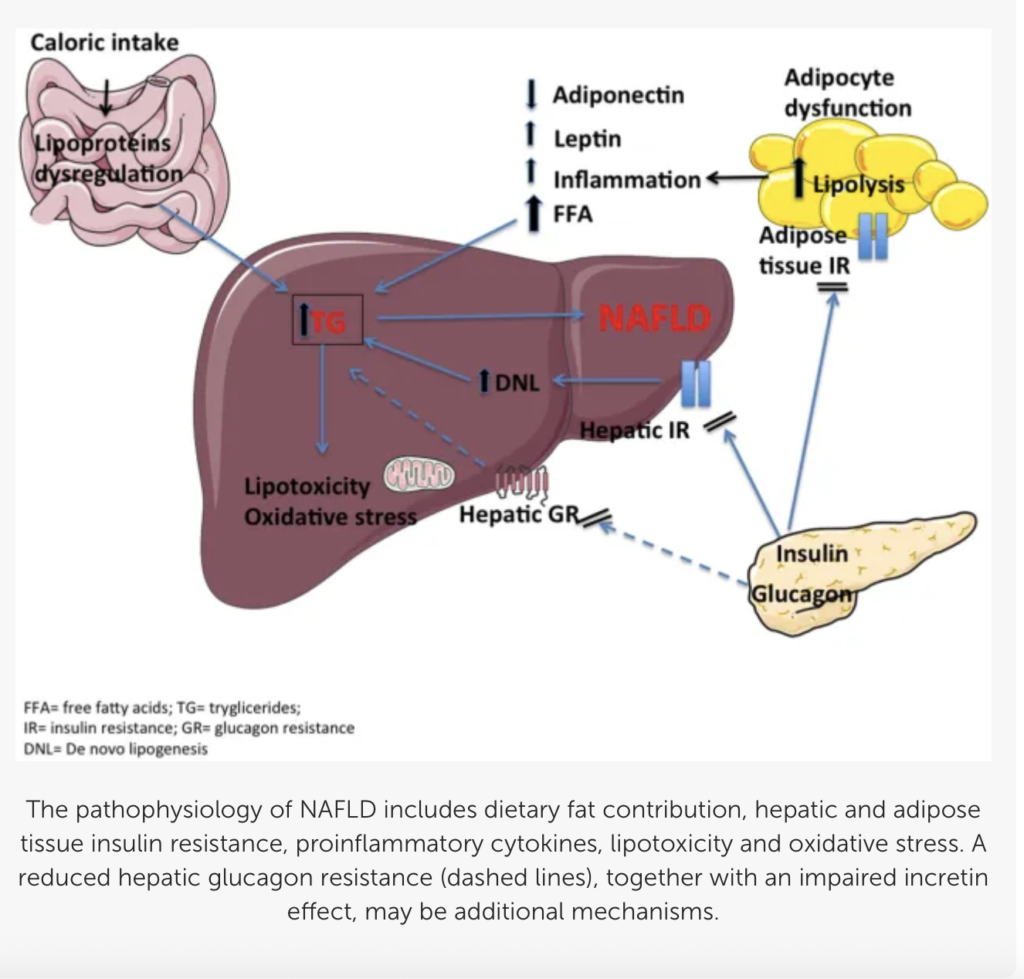
The pathophysiology of NAFLD involves dietary fat contribution, hepatic and adipose tissue insulin resistance, proinflammatory cytokines, lipotoxicity, and oxidative stress. A reduced hepatic glucagon resistance, together with an impaired incretin effect, may be additional mechanisms. Source: Tilg H & Moschen AR, Front Endocrinol. 2018. DOI: 10.3389/fendo.2018.00649[3]
What the biopsy data is starting to show
Liver biopsy is the gold standard for assessing NASH progression. Blood tests and imaging give proxies; biopsy gives tissue-level information that cannot be inferred from the scale. The question of whether semaglutide improves liver function beyond metabolic proxy markers is now being examined at the histological level.
The Phase 3 ESSENCE trial (NCT04822181) is a 240-week study with biopsy-confirmed primary endpoints, currently ongoing. Published 72-week interim data from approximately 800 participants show early histological improvement signals in the semaglutide arm, with NASH resolution and fibrosis regression trends favoring treatment over placebo.[2] These are interim findings from an unfinished trial. Specific efficacy figures from this readout should not be treated as final; the 240-week primary endpoint data is not yet available.
What the interim data does not answer is whether these early biopsy signals translate to cirrhosis prevention over decades, or how durable the effects are after discontinuation. The evidence base is actively accumulating. The 240-week readout is the threshold that matters for definitive conclusions.
What This Means if the Scale Is Not Moving as Expected
For patients on GLP-1 therapy who also carry a confirmed MASLD diagnosis, the Phase 2 evidence and the direction of ongoing Phase 3 work shift what progress looks like during treatment. Weight loss amplifies liver benefit, and significant reduction remains a meaningful clinical target. But modest weight loss, or a plateau, does not necessarily mean the liver is stalled.
Monitoring with liver function tests (ALT, AST, GGT) and follow-up imaging at six-to-twelve month intervals gives a more complete picture of hepatic response than BMI alone. If you have fatty liver and are using a GLP-1 agonist for metabolic reasons, baseline and follow-up liver assessments are worth discussing with your clinician.
A few caveats to hold alongside this data: semaglutide is not currently approved specifically for MASLD treatment in most markets. The liver effects described here are observed in patients using GLP-1 therapy for metabolic disease who also have fatty liver, a common clinical overlap, but an off-label liver-specific indication in most jurisdictions. Individual responses vary. Patients with advanced fibrosis (stage 3-4) or cirrhosis are outside the population studied in these trials, and the data should not be extrapolated to those stages without careful clinical review.
The GLP-1 and fatty liver disease signal may be one of the more clinically meaningful non-scale outcomes in metabolic medicine right now. The mechanism is real, Phase 3 biopsy work is actively underway, and the implications for the large population of patients where metabolic disease and MASLD overlap are significant. The 240-week ESSENCE data will determine how strong that signal actually is.
The weight-loss story is not wrong. It is just not the full story.
Join the Field Notes
Metabolic Field Notes tracks the evidence as it develops, without protocol-pushing and without hype. If evidence-aware, translational science is useful to you, join the Field Notes.
REFERENCES
[1] Newsome PN, Buchholtz K, Cusi K, et al. A Placebo-Controlled Trial of Subcutaneous Semaglutide in Nonalcoholic Steatohepatitis. N Engl J Med. 2021;384(12):1113-1124. PMID: 33185364. DOI: 10.1056/NEJMoa2028395
[2] ESSENCE Trial. Semaglutide 2.4mg vs placebo in biopsy-confirmed NASH. 72-week interim results from a 240-week Phase 3 trial. NCT04822181. Novo Nordisk. PMID: 40305708. DOI: 10.1056/NEJMoa2502780
[3] Tilg H, Moschen AR. Evolution of inflammation in nonalcoholic fatty liver disease: The multiple parallel hits concept. Front Endocrinol (Lausanne). 2018;9:649. DOI: 10.3389/fendo.2018.00649
Medical Disclaimer: The content on this blog is for informational and educational purposes only and does not constitute professional medical advice, diagnosis, or treatment. Always seek the advice of your physician or other qualified health provider with any questions you may have regarding a medical condition.


Pingback: Fatty Liver Disease Burden in India: The Hidden Scale
Pingback: India's Hidden Sleep Crisis: Why 104 Million Cases Stay Hidden
Pingback: Sleep Apnea & Insulin Resistance: The Nightly Mechanism
Pingback: GLP-1 Receptor Agonists Beyond Obesity: Evidence Review