


Your period came early. Or late. Or lighter. Or it stopped for a month.
Since starting your GLP-1 medication, something shifted and you’re not sure if it’s the medication, the weight loss, or something you should be worried about.
This guide covers what happens to your menstrual cycle on GLP-1 therapy, which changes are expected, which ones need a doctor conversation, and how to track what’s happening so that conversation is useful.
Why Your Cycle Changes on GLP-1
The menstrual changes many people notice on GLP-1 therapy are primarily understood as an indirect effect – driven by rapid weight loss and improved insulin sensitivity acting on the hormonal signals that regulate your cycle, rather than a well-established direct action of the drug on your ovaries. That said, this isn’t a fully settled question. A growing body of preclinical research has identified GLP-1 receptors in ovarian tissue itself, and some of it points to a possible direct effect on follicular development that doesn’t depend on weight loss alone.[1] The evidence for this direct pathway is still early and comes mainly from animal studies, not yet confirmed in human trials – more on the specific findings below.
Fat tissue produces estrogen, and the balance between estrogen, progesterone, and the hormones that regulate your cycle (LH and FSH) is sensitive to how much fat mass you’re carrying and how fast that changes. This relationship is well established in weight-loss research generally; a dedicated GLP-1 study confirming the same magnitude of hormonal shift does not yet exist, so this is mechanistic reasoning extended from general weight-loss endocrinology, not a GLP-1-specific finding.[2]
For women with PCOS, GLP-1 therapy is associated with more regular cycles over time, alongside improved insulin sensitivity and modest reductions in some androgen markers. The exact mechanism is still debated – the largest trial in this space found the menstrual improvement tracked more closely with weight loss itself than with the change in insulin resistance, and a 2025 meta-analysis found androgen levels did not reliably improve across pooled trials even though insulin resistance did. In practice, this means the cycle benefit in PCOS is real and reasonably well documented, but “lower insulin resistance directly causes fewer androgen-driven disruptions” is a simpler story than the data currently support.[2]
This is the direct-pathway evidence mentioned above: a 2020 mouse study found GLP-1 receptors on ovarian granulosa cells and a direct effect on granulosa cell survival, a process tied to follicular development. This is animal evidence only – it has not been established in human clinical trials – and your doctor may not raise it unless you ask.[3]
Normal Changes vs. Changes That Need Attention
Most cycle changes in the first 3-6 months of GLP-1 therapy fall into the “expected” category. Here’s a simple framework:
Changes that are common and usually temporary:
- Cycle arrives 3-7 days earlier or later than usual
- Lighter flow than you’re used to
- Mild spotting between periods in month 1-2
- Skipping a period once, especially if weight loss was rapid that month
Changes that need a doctor conversation this week:
- Two or more missed periods in a row (rule out pregnancy if relevant)
- Soaking through a pad or tampon every hour for two or more consecutive hours – a recognized marker of heavy menstrual bleeding
- Significant pain that is new or worsening
- Bleeding or spotting that lasts more than 7 days
- Cycle becomes irregular after being regular for years, and stays that way past month 6
The distinction matters because temporary irregularity during active weight loss is a known pattern. Persistent irregularity, or new and heavy bleeding, can signal something unrelated to your medication that warrants investigation.
A Simple Tracking System
Tracking your cycle while on GLP-1 doesn’t require a complex app. You need four data points per cycle:
- Start date – the day bleeding begins
- Flow intensity – light, moderate, or heavy (use your own consistent definition)
- Duration – how many days until bleeding stops
- Symptoms – anything new: cramps, spotting, pain
Record these every month. After three months, bring this log to your doctor. “My period seems different” is a starting point; “my cycle moved from day 28 to day 22 over the last three months, and flow has been lighter” is information your doctor can work with.
If you use a period-tracking app, add a note field for medication status. Your doctor needs to know whether cycle changes started before or after your GLP-1 dose was adjusted.
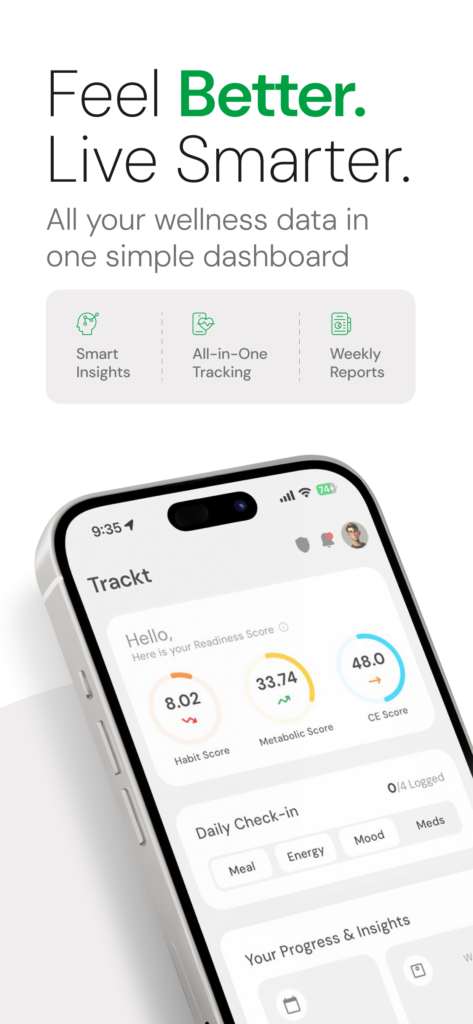
Track your symptoms, energy, meals, and questions so your doctor visit is clearer. A tool like TRACKT makes this easy — a short daily log, helps your doctor understand exactly what you’re experiencing.
If You Have PCOS
GLP-1 therapy often has the most visible cycle impact in women with PCOS. In a randomized trial of women with PCOS, adding semaglutide to metformin restored menstrual cycles in 72.5% of participants over 16 weeks, compared with 42.3% on metformin alone – alongside weight loss and reductions in testosterone and free androgen index.[4] A second, independent trial by Zhang et al. (2026) found a similar pattern – 86.87% cycle recovery with semaglutide plus metformin versus 60.00% with metformin alone.[4] Both trials studied semaglutide combined with metformin, not semaglutide alone, and measured cycle recovery through patient-recorded bleeding diaries rather than confirmed ovulation – so “cycles became regular” is well supported, but “ovulation is fully restored” is a reasonable inference, not a directly proven one. Tirzepatide-specific trial data on cycle regularity is not yet published; a dedicated trial is currently underway.
This is a positive change, but it comes with a caution: more regular cycles in women with PCOS can mean ovulation is returning. If you are not trying to conceive, discuss contraception with your gynaecologist before your next dose. This caution is drug-specific, not a GLP-1 class effect: tirzepatide (Mounjaro, Zepbound) carries an FDA label warning that it can reduce oral contraceptive absorption due to delayed gastric emptying, and the manufacturer recommends switching to a non-oral contraceptive method or adding a barrier method for 4 weeks after starting tirzepatide and for 4 weeks after each dose increase. Semaglutide, liraglutide, dulaglutide, exenatide, and lixisenatide have been studied specifically for this interaction and do not show a clinically meaningful effect on oral contraceptive absorption. If you are on tirzepatide, ask your doctor or pharmacist whether your specific contraceptive needs backup protection.[5]
If you are trying to conceive, speak to your doctor before continuing GLP-1 therapy. These medications are not currently recommended during pregnancy, and the interaction between returning fertility and active GLP-1 use is a clinical conversation, not something to navigate alone.
When to Stop Waiting and Call Your Doctor Today
Track your cycle, yes – but don’t track instead of acting.
Call your doctor today if you experience:
- Complete absence of your period for 90 days (3 months) or more – if your cycles were already irregular before starting treatment, this threshold is sometimes extended to 6 months, but 3 months is the safer line to act on
- Sudden heavy bleeding with dizziness or weakness
- A positive pregnancy test while on GLP-1 medication
- New, severe pelvic pain
These are not situations where “I’ll mention it at my next appointment” is the right plan. Each of these warrants a same-day call.
A Note on Evidence Gaps
Most of what we know about GLP-1 and menstrual cycles comes from indirect evidence – from weight loss studies, PCOS trials, and hormonal research. Dedicated studies on cycle tracking in non-PCOS women on GLP-1 therapy are limited. Your experience may not match exactly what published data describes.
This matters because your doctor needs your actual tracking data, not a general expectation. The tracking system above exists for exactly this reason.
Track Your Symptoms, Energy, Meals, and Questions
Changes in your cycle are data. So is your energy on certain days, how your appetite shifts through the month, and which side effects you noticed after each dose. Keeping that information in one place – before your doctor visit – makes a real difference in what your doctor can do with it.
Join the Field Notes for tools and guidance for people managing their metabolic health with intention.
This article is for educational purposes only and does not replace medical advice. If you are experiencing menstrual changes while on GLP-1 therapy, speak to your doctor. Track your symptoms, cycle dates, and questions so your appointment is clearer.
Join the Field Notes
Metabolic Field Notes tracks the evidence as it develops, without protocol-pushing and without hype. If evidence-aware, translational science is useful to you, join the Field Notes.
References
[1] Voros C, et al. “A Systematic Review on GLP-1 Receptor Agonists in Reproductive Health.” Int J Mol Sci. 2026;27(2):759. DOI: 10.3390/ijms27020759 — PMC12841515.
[2] Itriyeva K. “The effects of obesity on the menstrual cycle.” Curr Probl Pediatr Adolesc Health Care. 2022;52(8):101241. DOI: 10.1016/j.cppeds.2022.101241 — PMC9449629.
[3] Sun Z, et al. “GLP-1/GLP-1R Signaling Regulates Ovarian PCOS-Associated Granulosa Cells.” Int J Endocrinol. 2020;2020:1484321. DOI: 10.1155/2020/1484321 — PMC7321515. Mouse model only.
[4] Chen H, et al. “Effects of combined metformin and semaglutide therapy on PCOS.” Reprod Biol Endocrinol. 2025;23:108. DOI: 10.1186/s12958-025-01447-3 — PMC12297736. 72.5% vs 42.3% cycle recovery. Also: Zhang W et al. Metab Target Organ Damage. 2026;6:10. DOI: 10.20517/mtod.2025.210. 86.87% vs 60.00% (n=64, P=0.038).
[5] FSRH CEU. “GLP-1 agonists and oral contraception.” Jan 2025. Full PDF. Consistent with FDA tirzepatide label and Skelley JW et al. J Am Pharm Assoc. 2024;64(1):204–211. PubMed 37940101. Thresholds from ACOG guidelines.