

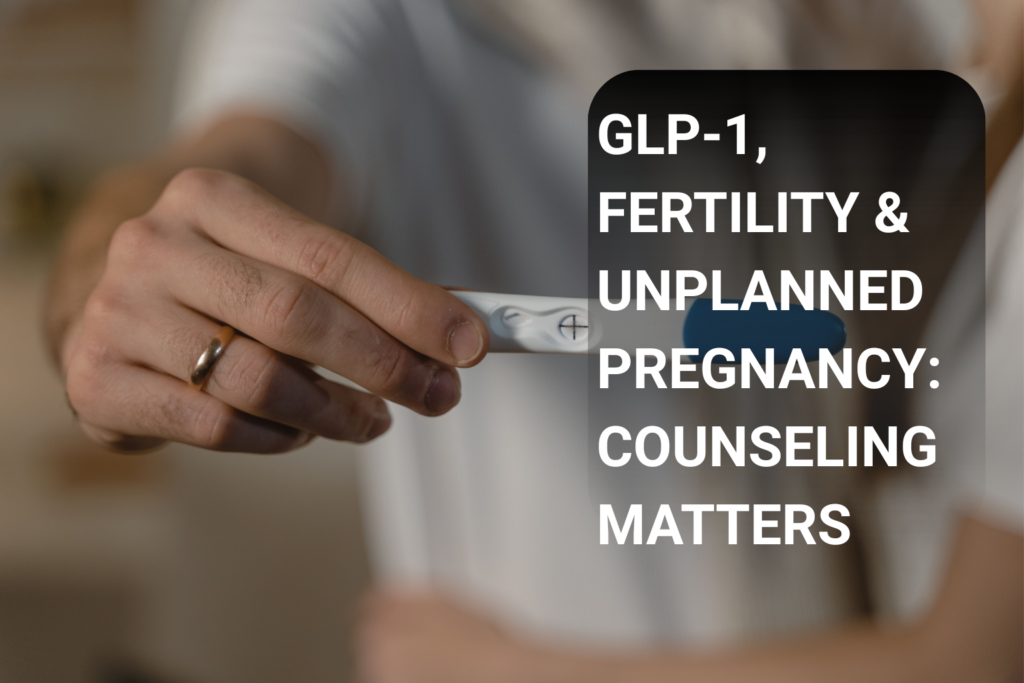
A woman starts a GLP-1 medication for weight management. Nobody discusses contraception at that visit, because nobody thinks of it as a fertility conversation. Three months later, her periods ,absent for years because of PCOS return without warning. So does the possibility of pregnancy she wasn’t planning for and wasn’t prepared to prevent.
This is not a rare edge case. It is a predictable, mechanism-based outcome that pre-treatment counseling can catch , but only if the conversation happens before the prescription, not after a missed period.
Why Fertility Can Return Faster Than Expected
For women with PCOS-related infertility, the connection between GLP-1 therapy and improved fertility is not speculative. A meta-analysis of 11 clinical trials in women with PCOS found that GLP-1 receptor agonists significantly improved menstrual regularity and increased natural pregnancy rates compared with other treatments.[1] The mechanism runs through more than one pathway: weight loss and improved insulin sensitivity correct the hormonal disruption that suppresses ovulation in PCOS, and some evidence points to a more direct ovarian effect – enhanced follicular maturation independent of weight change.[2]
For someone who has spent years being told her irregular or absent cycles made pregnancy unlikely without fertility treatment, this can be the first real sign that her body’s reproductive system is recalibrating. That is meaningful news for someone trying to conceive. It is a different kind of news entirely for someone who is not.
The gap in the current evidence is worth naming honestly: researchers still don’t have clear data on how this plays out in women without PCOS, women with normal weight, or women with other causes of anovulation – the ideal timing, dose, and duration for a fertility effect remain unclear even in the population that’s been studied most.[2] What is clear is the direction: ovulation can return, and it can return without an obvious signal beforehand.
A Second Mechanism: When the Pill Itself Stops Working as Well
There is a separate, distinct risk that has nothing to do with ovulation returning and it applies specifically to tirzepatide (Mounjaro, Zepbound), not semaglutide.
Tirzepatide slows gastric emptying, and the FDA label for Zepbound states this can reduce the absorption and effectiveness of oral hormonal contraceptives.[3] The effect is dose- and time-dependent: it is largest after the first dose or after a dose increase, and it diminishes with continued use at a stable dose. In the clinical trial data behind the label, a single 5mg tirzepatide dose reduced peak blood levels of the contraceptive hormones ethinyl estradiol and norgestimate by 55-66%.[3]
Because of this, the FDA recommends that anyone using an oral contraceptive pill switch to a non-oral method, or add a barrier method, for four weeks after starting tirzepatide and for four weeks after every dose increase.[3] This is not a one-time precaution – it applies again each time the dose goes up, which for many people happens every four weeks during the standard escalation schedule.
These two mechanisms are easy to conflate but function completely differently. One is about a return of fertility (relevant mainly to PCOS and anovulatory patients, applies broadly across GLP-1 medications). The other is about reduced contraceptive reliability from a specific drug interaction (relevant to tirzepatide specifically, tied to gastric emptying, and time-limited around dose changes). A counseling conversation that only covers one of these leaves a real gap.
What Pre-Treatment Counseling Should Actually Cover
Given both mechanisms, a pre-treatment conversation before starting any GLP-1 medication should include:
- Current pregnancy intentions – planning for, avoiding, or unsure
- Current contraception method, and whether it is oral or non-oral
- If oral contraception is in use alongside tirzepatide specifically: the four-week barrier-method or method-switch recommendation, repeated at each dose increase
- Menstrual and ovulation history – especially for anyone with PCOS or a history of irregular cycles, since this is the group most likely to see fertility return
- A plan for what happens if pregnancy occurs while on the medication, since GLP-1 medications are not approved for use during pregnancy and current guidance is to discontinue treatment before a planned conception attempt, typically with enough lead time for the drug to clear the system
None of this is a reason to avoid these medications. It is a reason to have the conversation at the start, when a plan can still be made, rather than after a missed period turns it into a scramble.
Why This Gets Missed in Practice
Weight-management and diabetes visits are usually structured around metabolic goals – glucose, weight, cardiovascular risk. Reproductive counseling sits in a different part of a doctor’s mental checklist, often addressed only if the patient raises it herself. For a medication that can simultaneously restore fertility in one pathway and undermine contraceptive reliability through another, that gap in the standard visit script has real consequences.
If your doctor has not brought this up, it is worth raising yourself – particularly if you have PCOS, irregular cycles, or use an oral contraceptive alongside tirzepatide.
Track What Your Body Is Telling You
A return of regular cycles after years of irregularity is easy to miss as a fertility signal if nobody has framed it that way in advance. Track your cycle changes alongside your other symptoms, and bring them to your next visit – not just as a side note, but as a direct question about what it means for your plans.
Track your symptoms, energy, meals, and questions so your doctor visit is clearer. A tool like TRACKT makes this easy — a short daily log, helps your doctor understand exactly what you’re experiencing.
This content is for informational and educational purposes only. It does not constitute medical advice, diagnosis, or treatment. Always consult a qualified healthcare professional before making changes to your medication, diet, or health routine.
Join the Field Notes
Metabolic Field Notes tracks the evidence as it develops, without protocol-pushing and without hype. If evidence-aware, translational science is useful to you, join the Field Notes.
References
1. Ye et al. “Effects of GLP1RAs on pregnancy rate and menstrual cyclicity in women with polycystic ovary syndrome: a meta-analysis and systematic review.” BMC Endocrine Disorders, 2023.
2. Cena H, Chiovato L, Nappi RE. “Obesity, Polycystic Ovary Syndrome, and Infertility: A New Avenue for GLP-1 Receptor Agonists.” J Clin Endocrinol Metab. 2020;105(5):e2695-e2709. PMID: 32442310.
3. U.S. Food and Drug Administration. ZEPBOUND (tirzepatide) injection prescribing information – Drug Interactions section (oral hormonal contraceptives, delayed gastric emptying). accessdata.fda.gov/drugsatfda_docs/label/2025/217806s031lbl.pdf.