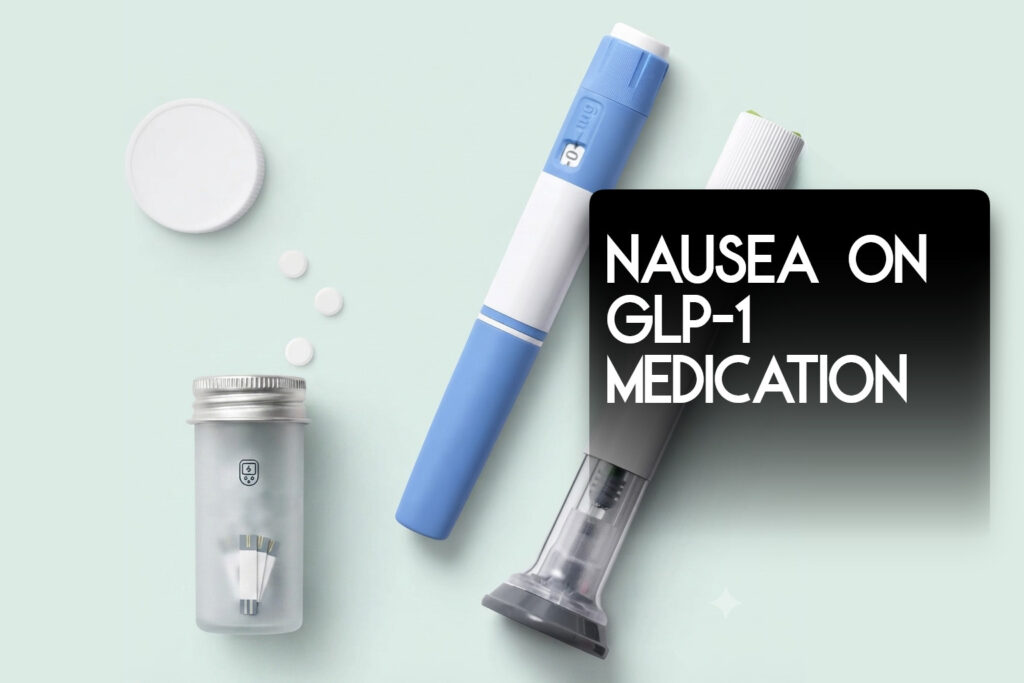


Your doctor said the nausea would pass. Here’s how to tell if that’s still true.
It usually starts in the first few weeks. A queasy feeling after meals. Maybe some vomiting. You keep wondering if this is just part of adjusting, or something you should actually worry about.
Most people on GLP-1 medications like semaglutide or liraglutide do experience nausea, especially when starting or when the dose goes up. And for most, it fades. But “it’ll pass” isn’t the same as “ignore it no matter what.”
Understanding the difference between normal adjustment and something that needs attention puts you in control. Your body is sending signals. This article helps you read them.
Started without a prescription? You’re not alone. Many people in India access GLP-1 medications without ongoing doctor supervision. These symptoms still matter, and you still deserve proper care. If you don’t have a regular doctor, see the section “If You Don’t Have a Doctor” near the end.
Why Does GLP-1 Medication Make You Feel Sick?
GLP-1 medications slow down how fast your stomach empties. That’s actually part of how they work. Food stays in your stomach longer. This helps you feel full sooner and keeps your blood sugar steadier after meals.[1]
But the same mechanism that steadies your glucose can also make your stomach feel unsettled. Your gut isn’t used to this new pace. It needs time to adapt.
Think of it as a traffic slowdown on a busy road. The route still works; it just takes a bit longer to clear. For most people, that adjustment takes 4 to 6 weeks.[2] Everyone adjusts at a different pace.
Nausea tends to be worst in the first week of a new dose. If your dose was just increased, that’s a common trigger. Unsupervised users are more likely to start too high or escalate too fast, and both make nausea significantly worse.
You can read more about how GLP-1 affects your weight, appetite, and nausea together in Blog 07, our earlier deep-dive on the three main effects.
Once you understand why it happens, the next question is how to tell what’s normal and what isn’t.
What Does Normal GLP-1 Nausea Feel Like?
Normal nausea after starting a GLP-1 tends to follow a recognizable pattern. It usually:
- Appears within a few hours after your injection or a meal
- Feels like general queasiness, not sharp or stabbing pain
- Gets better within a day or two after each new dose
- Slowly improves week by week
- Doesn’t stop you from drinking water or fluids
Some people feel almost nothing. Others feel it more intensely, especially in the first two weeks. That variation is normal.
What matters more than the intensity is the direction: nausea should be getting better over time, not worse.
When Should You Call Your Doctor?
Some symptoms shouldn’t be waited out. Contact your doctor if you notice any of these:
Vomiting you can’t stop. Occasional vomiting is common. But if you can’t keep fluids down for more than 24 hours, that’s a medical concern that needs attention.
Sharp pain in your upper abdomen. GLP-1 medications have been associated, in rare cases, with pancreatitis (inflammation of the pancreas). If you feel a severe, persistent pain in your upper abdomen that spreads to your back, stop the medication and call your doctor right away.[3]
Signs of dehydration. Dark urine, dizziness, extreme dry mouth: these mean your body needs fluids and possibly medical support soon.
Nausea that’s getting worse after 8 weeks. By this point, things should be improving. If they’re not, your doctor may need to look at your dose or explore another option.
Traditional remedies and Ayurvedic medicines. If you’re taking any herbal or Ayurvedic products for diabetes, weight, or digestion (karela, methi, vijaysar, gurmar, or similar), tell your doctor. Some of these affect blood sugar and digestion in ways that can interact with GLP-1 medications and intensify nausea. This isn’t about stopping them; it’s about your doctor knowing the full picture.
Small Changes That Often Help
You don’t have to wait it out passively. Most people find at least one of these adjustments cuts the nausea noticeably:
Eat smaller meals. Your stomach is emptying slowly, so large meals can overwhelm it. Try eating half as much, more often.
Avoid fatty or spicy foods in the first few weeks. These take longer to digest and can intensify nausea.
Take your injection at night, if your doctor agrees. Many people sleep through the worst of the side effects this way.
Stay upright for 30 minutes after eating. Lying down right after a meal slows digestion further.
Sip water throughout the day. Dehydration makes nausea worse. Small, frequent sips are easier to manage than trying to drink a lot at once.
If you recently switched brands or devices and nausea suddenly got worse, bring it up with your pharmacist. Dosing accuracy can vary between pen devices and vials. A pharmacist can help you check whether the switch may be a factor.
If You Don’t Have a Doctor, These Symptoms Still Need Attention
Nausea that won’t stop, severe abdominal pain, or signs of dehydration are reasons to seek care, whether or not you have a regular doctor.
Here’s where to start in India:
- Government hospitals and CHCs (Community Health Centres): available in most districts, capable of managing medication-related side effects
- Telemedicine platforms (e.g., eSanjeevani, Practo, mfine): a quick video consultation can help you decide if you need in-person care
- Endocrinology outpatient clinics: most large government and private hospitals have one; no referral required in most states
- Your local pharmacist: a first step if nothing else is available; they can assess severity and direct you appropriately
You don’t need to be on a formal prescription plan to deserve medical attention. If something feels wrong, it’s worth a call or visit.
Join the Field Notes
Metabolic Field Notes tracks the evidence as it develops, without protocol-pushing and without hype. If evidence-aware, translational science is useful to you, join the Field Notes.
REFERENCES
“GLP-1 gastric emptying mechanism slowing” — expected: Drucker DJ. The biology of incretin hormones. Cell Metab. 2006;3(3):153-165]
“semaglutide nausea incidence duration weeks GLP-1” — expected: Wilding JPH et al. 2021 STEP 1 N Engl J Med PMID 33567185 or Davies M et al. 2021 STEP 2]
“GLP-1 receptor agonist pancreatitis risk rare” — expected: Steinberg WM et al. or regulatory label pancreatitis data semaglutide]
Medical Disclaimer: The content on this blog is for informational and educational purposes only and does not constitute professional medical advice, diagnosis, or treatment. Always seek the advice of your physician or other qualified health provider with any questions you may have regarding a medical condition.