


A few months into semaglutide, something unexpected: the scale was moving, but so was strength. Clothes fit differently, but not quite as expected. Fatigue arrived earlier in workouts that used to feel routine. The number on the scale looked like progress. The mirror told a more complicated story.
This experience is more common than most patients are told. Weight loss on GLP-1 medications is real, measurable, and well-documented. But what comes off the body is not always what people assume. And the two effects that accompany the weight loss, reduced appetite and nausea, are not simple side effects to be tolerated. They are biological responses worth understanding.
GLP-1 medications produce three predictable changes in the body. Each one has a distinct mechanism. And each one interacts with the others in ways that matter for how you manage the experience.
Why Your Muscles Don’t Know You’re on a Diet
The relationship between GLP-1 therapy and muscle loss is not a simple chain of cause and effect. It is more accurate to describe it as a set of converging pressures, each of which contributes differently depending on the individual.
The most direct contributor is caloric restriction. GLP-1 receptor agonists suppress appetite through multiple pathways: slowing gastric emptying, modulating hypothalamic hunger circuits, and reducing the reward value of food. For many users, caloric intake drops substantially in the first weeks of treatment. The body responds to sustained caloric deficit the same way it has evolved to respond to food scarcity: it mobilizes multiple fuel sources, including lean tissue.
But the picture is not simply “less food in, less muscle retained.” The rate of weight loss matters. The ratio of fat to lean mass lost tends to worsen when weight comes off very quickly, a pattern seen across weight loss interventions and not specific to GLP-1 therapy. Metabolic adaptation also plays a role: as the body senses a prolonged energy deficit, it begins to preferentially protect fat stores (a higher-priority survival reserve) while allowing lean mass to turn over more readily.
There is also emerging evidence that GLP-1 receptors may be expressed in skeletal muscle tissue directly, though the clinical significance of this remains an active area of investigation.[2][3] What this means in practice is that the effects on lean mass are likely multi-factorial and not reducible to a single cause.
Data from the STEP 1 trial show that approximately 25-40 percent of total weight lost comes from fat-free mass.[1] This is consistent with what is seen in other significant weight loss contexts, including bariatric surgery. The proportion can be shifted with deliberate behavioral strategies, particularly resistance exercise and adequate protein intake, but it is unlikely to reach zero under any circumstances of meaningful weight loss.
The Appetite Signal: More Complex Than “Feeling Full”
GLP-1 (glucagon-like peptide 1) is produced naturally in the gut and brain. When food is consumed, intestinal L-cells release GLP-1, which travels via the bloodstream and vagus nerve to the hypothalamus, where it binds to receptors in the arcuate nucleus and reduces hunger signaling.[3]
GLP-1 receptor agonists mimic and extend this process. They slow gastric emptying, which prolongs the physical sensation of fullness after eating. They also activate GLP-1 receptors in the nucleus tractus solitarius in the brain stem, a region that processes satiety signals from the gut, and in hypothalamic areas that regulate food reward and motivational eating.[3]
The result is not simply “feeling full sooner.” It is a quieter relationship with food at the neurological level. Cravings for highly palatable, calorie-dense foods tend to diminish. The urgency that often accompanies hunger decreases. Some users describe it as the food “noise” going down.
This central appetite modulation is distinct from the gut-level satiety effects, and both are occurring simultaneously. That is why appetite suppression from GLP-1 medications can feel qualitatively different from caloric restriction alone, which is also why it tends to be more durable for many people over time.
Nausea as a Dose-Response, Not a Side Effect
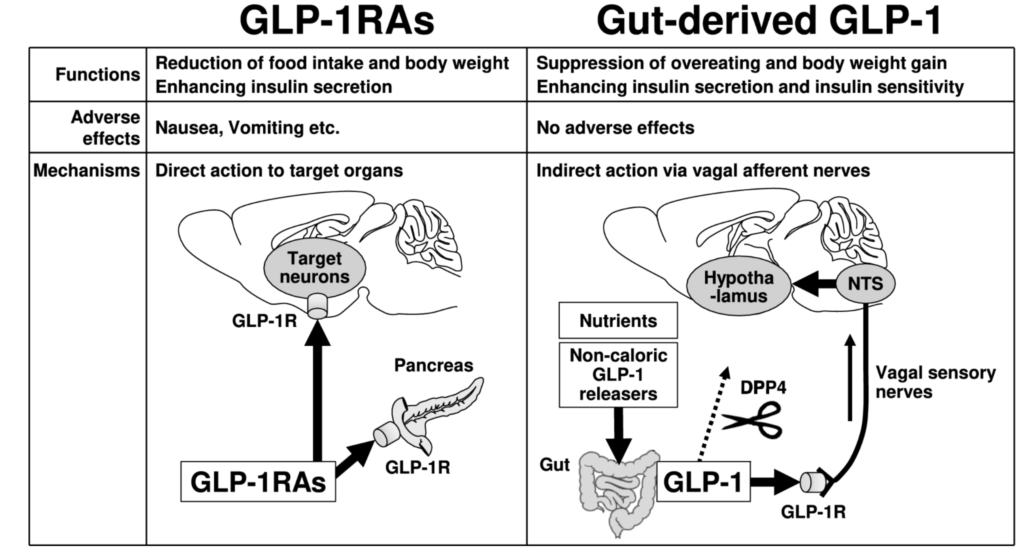
Nausea is the most commonly reported adverse effect with GLP-1 medications. In the STEP 1 trial, approximately 44 percent of participants on semaglutide 2.4 mg reported nausea during the study period, compared with 16 percent in the placebo group.[1] For many users, this experience defines their first weeks on the medication.
The mechanism is predictable. GLP-1 receptors are present in the area postrema, a brain stem region with a modified blood-brain barrier that functions as a chemoreceptor trigger zone, monitoring circulating blood content and initiating nausea responses. When GLP-1 receptor agonist levels rise quickly, as happens when a new dose is introduced or escalated, the area postrema responds.[4]
A useful comparison: nausea on GLP-1s behaves less like an allergic reaction (unpredictable, potentially permanent) and more like motion sickness. It is a sensory mismatch. The body’s nausea circuitry is reacting to an unfamiliar signal intensity. As receptor accommodation occurs over several weeks, the response diminishes.
This is borne out in the data. For the majority of users who experience nausea, it peaks in the first 4 to 8 weeks of a new dose and decreases substantially by weeks 12 to 20.[1] The slow dose-escalation schedules built into GLP-1 protocols are not arbitrary. They exist specifically to allow accommodation at a manageable rate.
The Three Effects Are Connected: Working With Each One
These three effects do not operate independently. They share a common thread: the body responding to a rapid and sustained change in its metabolic state.
Appetite suppression reduces caloric intake. Reduced caloric intake, combined with the rate and pattern of weight loss, contributes to lean tissue mobilization. Nausea in early weeks can further reduce food intake beyond appetite suppression alone, adding another variable to the energy equation during the period when the body is already adjusting.
Understanding these connections suggests distinct strategies for each effect, not a single unified approach.
For lean mass: resistance exercise provides a physiological signal to preserve muscle even under caloric restriction. Adequate protein intake supports muscle protein synthesis and helps offset the catabolism that accompanies rapid weight loss.[2] Current nutritional guidelines for weight loss contexts recommend approximately 1.2 to 1.6 grams per kilogram of body weight per day, though individual needs vary.[6]
For nausea: the strategies are different. Small, frequent meals reduce the volume load on a stomach that is already emptying slowly. Avoiding high-fat foods, which further delay gastric emptying, can reduce the intensity of nausea in the hours after eating. Timing the injection in the evening, so peak serum levels occur during sleep, is a practical approach for users whose nausea is worst in the morning. Slow dose escalation remains the most reliable management tool: the accommodation window that reduces nausea simply takes time, and the titration schedule is designed to give the body that time.
These are separate problems requiring separate solutions. Conflating them, or expecting a single dietary change to address both, misses the precision that makes the difference for people navigating the early weeks of treatment.
What the Research Actually Shows About Outcomes
The clinical data on these three effects over time tells a clearer story than the first few weeks of treatment suggest.
In the STEP 5 trial (104 weeks of semaglutide 2.4 mg), mean weight loss reached approximately 15 percent of body weight.[5] Fat mass accounted for the majority of that loss, particularly in participants who maintained physical activity. Nausea rates fell sharply after week 20, with serious gastrointestinal adverse events remaining low throughout.
Lean mass loss, while present, followed a pattern consistent with other significant weight loss interventions at comparable magnitudes. The subset of users who discontinue due to gastrointestinal effects is approximately 3 to 7 percent across major trials, meaningful but far lower than the initial nausea prevalence would suggest.[1][5]
What this means practically: the first 4 to 8 weeks of GLP-1 therapy are the most biologically demanding. Lean mass strategies (protein and resistance training) and nausea management strategies (meal size, fat content, injection timing) need to be active during this period to have any meaningful impact. By week 20, the picture is often considerably different. What happens in those early weeks shapes the body composition and tolerability outcomes that follow.
These three effects (muscle catabolism, quieted appetite, and dose-related nausea) are predictable biological responses to a specific class of drug acting on receptors distributed throughout the gut, brain stem, hypothalamus, and potentially muscle tissue. The mechanisms are distinct. The management strategies are distinct. What connects them is the same underlying event: a body adapting, quickly, to a new metabolic signal.
Understanding that adaptation, rather than just enduring it, is where meaningful outcomes begin.
Join the Field Notes
Metabolic Field Notes tracks the evidence as it develops, without protocol-pushing and without hype. If evidence-aware, translational science is useful to you, join the Field Notes.
REFERENCES
[1] Wilding JPH, Batterham RL, Calanna S, et al. Once-Weekly Semaglutide in Adults with Overweight or Obesity. N Engl J Med. 2021;384(11):989-1002. DOI: 10.1056/NEJMoa2012183. PMID: 33567185.
[2] Cava E, Yeat NC, Mittendorfer B. Preserving Healthy Muscle during Weight Loss. Adv Nutr. 2017;8(3):511-519. DOI: 10.3945/an.116.014506. PMID: 28507015.
[3] Drucker DJ. Mechanisms of Action and Therapeutic Application of Glucagon-like Peptide-1. Cell Metab. 2018;27(4):740-756. DOI: 10.1016/j.cmet.2018.03.001. PMID: 29617641.
[4] Nauck MA, Quast DR, Wefers J, Meier JJ. GLP-1 receptor agonists in the treatment of type 2 diabetes – state-of-the-art. Mol Metab. 2021;46:101102. DOI: 10.1016/j.molmet.2020.101102. PMID: 33068776.
[5] Garvey WT, Batterham RL, Bhatta M, et al. Two-year effects of semaglutide in adults with overweight or obesity: the STEP 5 trial. Nat Med. 2022;28(10):2083-2091. DOI: 10.1038/s41591-022-02026-4. PMID: 36216945.
[6] Barrea L, Caprio M, Camajani E, et al. Dietary patterns and low-calorie diet recommendations for patients receiving GLP-1 receptor agonists. Crit Rev Food Sci Nutr. 2024;64(1):100-117. DOI: 10.1080/10408398.2022.2107928. PMID: 35930319.


Pingback: Same Weight Gain, Different Metabolic Risk - GlasVEGAS Study
Pingback: How to Prepare for a Doctor Visit While Using GLP-1
Pingback: Nausea on GLP-1: Why It Happens and What to Ask Your Doctor
Pingback: GLP-1 Constipation, Bloating, and Reflux: What Helps