

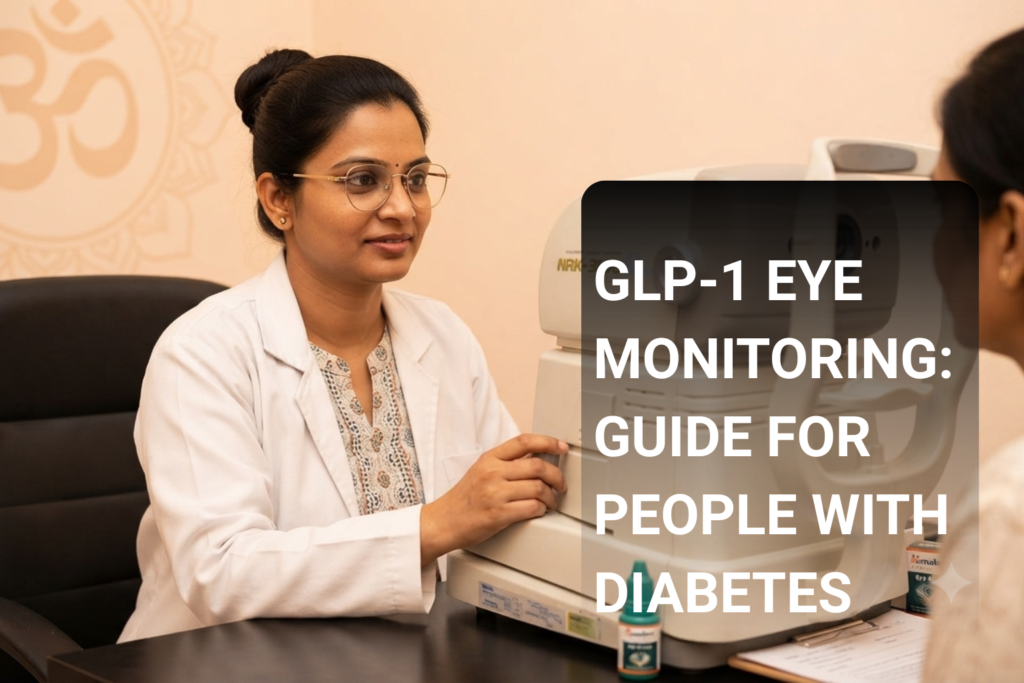
Your doctor prescribed a GLP-1 medication. Before you fill that prescription, there is one step you may need first: an eye exam.
This matters if you already have diabetic eye disease. GLP-1 medications lower blood sugar quickly. For some people with long-standing diabetes, that fast drop can temporarily stress small blood vessels in the eyes. This guide explains who needs diabetic retinopathy GLP-1 monitoring, what to watch for, and what to do about it.
What Is Diabetic Retinopathy, In Plain Terms
Think of your eye like a camera. At the back of your eye sits a thin layer called the retina. It captures light and turns it into images your brain can read.
Diabetes can damage the tiny blood vessels that feed the retina. Weak vessels can leak or bleed. This is called diabetic retinopathy. Many people with long-standing diabetes have some degree of this damage, even with no symptoms they can feel.
Why GLP-1s Can Temporarily Affect These Vessels
GLP-1 medications, such as semaglutide, lower blood sugar effectively. In the first few months of treatment, blood sugar can drop quite fast.
For someone with healthy retinal vessels, this is not a problem. But for someone whose vessels are already fragile, a rapid blood sugar drop can temporarily put extra stress on those vessels. Researchers call this early worsening. It does not happen to most people, but the risk is higher in those who start with very high blood sugar and lower it quickly.
A large clinical trial called SUSTAIN-6 found more reported retinopathy complications in people who used semaglutide compared to those who did not.[1] A follow-up analysis found that most of this risk was concentrated in people who had pre-existing retinopathy and experienced a large, rapid drop in HbA1c in the first 16 weeks of treatment.[2] The FDA now includes a warning about this on the semaglutide label. Most cases were mild, and this does not mean GLP-1 medications cause long-term harm to your eyes. It means the early transition period deserves attention.
Who Faces the Most Risk, and Who Probably Does Not
Some people are at higher risk of early retinopathy changes when starting a GLP-1 medication.
Higher risk: you already have moderate or severe diabetic retinopathy, your HbA1c is very high when you start (for example, above 10%), or you have had poorly controlled diabetes for many years. HbA1c is a three-month blood sugar average. Think of it as your blood sugar report card.
Lower risk: your eyes were recently checked and showed no retinopathy, your blood sugar is already reasonably controlled, or your doctor is starting you on a low dose and increasing it slowly.
Knowing which group you fall into helps you and your doctor make a plan.
Three Things to Do Before You Start GLP-1 Therapy
1. Get a baseline eye exam.
Ask your doctor for a dilated eye exam before you start your GLP-1 medication. This tells you the current condition of your retina. If retinopathy is already present, your doctor and eye specialist can plan a monitoring schedule together.
2. Know your HbA1c.
If your HbA1c is above 10 percent when you start, ask your doctor about a slower dose increase. A gradual blood sugar change is gentler on fragile retinal vessels than a sudden drop.
3. Schedule your follow-up exam now.
Most guidelines recommend a follow-up eye exam around three to six months after starting GLP-1 therapy if you have existing retinopathy. Book the appointment before you forget. Do not wait for symptoms, because early retinopathy changes often have none.
Consider Priya, a 52-year-old teacher with Type 2 diabetes and mild retinopathy. Her doctor arranged a baseline exam before semaglutide and a three-month follow-up. At the follow-up, her retina was stable. She continued GLP-1 therapy with a clear monitoring plan in place.
Retinopathy is not the only side effect worth monitoring on GLP-1s — but it is one that benefits most from early planning.
A Special Note for People Starting Indian Generic GLP-1s
India’s pharmaceutical market now offers generic semaglutide from several manufacturers. One of the largest Indian Phase III trials for generic semaglutide, Alkem’s SIZE-DM study (CTRI/2025/02/081490), explicitly excluded patients with diabetic retinopathy.[4]
This exclusion has a direct consequence: there is no India-specific safety data on retinopathy outcomes with these generics. The retinopathy signal from SUSTAIN-6 comes from the originator molecule, not from Indian generic formulations. Post-market surveillance for retinopathy in Indian generic users is currently limited.
If you have pre-existing retinopathy and are starting an Indian generic GLP-1, you are in an evidence gap. The baseline exam and three-month follow-up become even more non-negotiable, not less.
What to Do If Follow-Up Is Hard to Access
For people in tier-2 and tier-3 cities, the three-to-six month follow-up window may be hard to reach. An ophthalmology appointment can mean a long journey or a months-long wait.
Do not skip follow-up because of access barriers. The early worsening window is time-limited. Missing it means missing the opportunity to intervene.
If an ophthalmologist is not available, ask your prescribing physician about:
- Tele-retinal screening with a certified grader. Some districts and medical programmes now offer remote fundus image review.
- A local optometrist trained in fundus photography. They can capture retinal images that a remote specialist can grade.
- Referral to the nearest medical college ophthalmology department. Public hospital eye departments often have shorter wait times than private clinics.
The Bigger Picture: Short-Term Caution, Long-Term Hope
Evidence gaps exist here, and they are worth naming. Most studies on GLP-1 medications and the eye are short-term. We do not yet have solid five to ten year data on what these medications do to the retina over time.
What the existing evidence does show: GLP-1 medications improve blood sugar control, lower blood pressure, and reduce inflammation. All three of these are beneficial for blood vessel health over the long term. The concern is the early transition window, not the final destination.
The goal is not to avoid GLP-1 therapy if you have retinopathy. The goal is to start treatment with the right information and the right monitoring plan in place.
People who start GLP-1 therapy with a baseline eye exam and a clear follow-up schedule are not taking a chance. They are taking a well-informed step forward.
Join the Field Notes
Metabolic Field Notes tracks the evidence as it develops, without protocol-pushing and without hype. If evidence-aware, translational science is useful to you, join the Field Notes.
REFERENCES
[1] Marso SP, Bain SC, Consoli A, et al. Semaglutide and Cardiovascular Outcomes in Patients with Type 2 Diabetes. N Engl J Med. 2016;375(19):1834-1844. DOI: 10.1056/NEJMoa1607141. PMID: 27633186.
[2] Vilsboll T, Bain SC, Leiter LA, et al. Semaglutide, reduction in glycated haemoglobin and the risk of diabetic retinopathy. Diabetes Obes Metab. 2018;20(4):889-897. DOI: 10.1111/dom.13172. PMID: 29178519.
[3] US FDA. Ozempic (semaglutide injection) Prescribing Information. Novo Nordisk. [Retinopathy section: Warning and Precautions].
[4] Clinical Trials Registry India. SIZE-DM Study: Phase III Trial of Generic Semaglutide (Alkem Laboratories). CTRI/2025/02/081490.
Track your symptoms, energy, meals, and questions so your doctor visit is clearer. A tool like TRACKT makes this easy — a short daily log, helps your doctor understand exactly what you’re experiencing.
Medical Disclaimer: The content on this blog is for informational and educational purposes only and does not constitute professional medical advice, diagnosis, or treatment. Always seek the advice of your physician or other qualified health provider with any questions you may have regarding a medical condition.