
Three days after her doctor raised her GLP-1 dose, a shop owner in Bengaluru noticed her phone screen had gone soft at the edges. She blinked hard, cleaned her glasses, and blamed the fluorescent tube light above the counter. It did not clear by evening. It did not clear the next morning either.
That kind of blurriness is common on GLP-1 medication, and for most people it is not a sign that anything has gone wrong. But “usually harmless” is not the same as “ignore it.” By the end of this piece, you will know which blurry-vision pattern is worth mentioning at your next visit, and which pattern needs a call today.
Why Vision Gets Blurry When Blood Sugar Moves Fast
The lens inside your eye is sensitive to shifts in blood glucose and the sensitivity runs in both directions. When glucose drops quickly after starting or increasing a GLP-1 dose, or rises significantly, an enzyme called aldose reductase converts glucose into sorbitol inside the lens. Sorbitol accumulates faster than it clears, altering the osmotic pressure within the lens and changing its refractive properties. This can temporarily shift your effective spectacle prescription , things go soft at the edges or hard to focus up close.
This is not eye damage. It is not diabetic retinopathy. It is a temporary refractive shift, and it typically settles as blood sugar stabilizes at its new baseline, usually within a few weeks. Do not rush out for a new glasses prescription during this window – your eyes may still be recalibrating.
This is standard diabetes patient-education explanation for why blurry vision often follows any fast change in blood sugar control, not GLP-1 medication specifically. Keep it separate in your mind from the retinopathy-specific data below – they are different mechanisms.
What the Research Actually Shows About Retinopathy Risk
For people who already have diabetic retinopathy – damage to the small blood vessels in the retina from years of elevated blood sugar – the picture is more specific, and worth taking seriously.
In the SUSTAIN-6 cardiovascular outcomes trial, the two-year trial that established semaglutide’s cardiovascular safety profile, retinopathy complications (vitreous hemorrhage, blindness, or conditions needing treatment with an eye injection or laser) occurred in 3.0% of people on semaglutide versus 1.8% on placebo.[1][2] The gap widened sharply for people who already had retinopathy at the start of the trial: 8.2% versus 5.2%. For people without existing retinopathy, the difference was small: 0.7% versus 0.4%.[1]
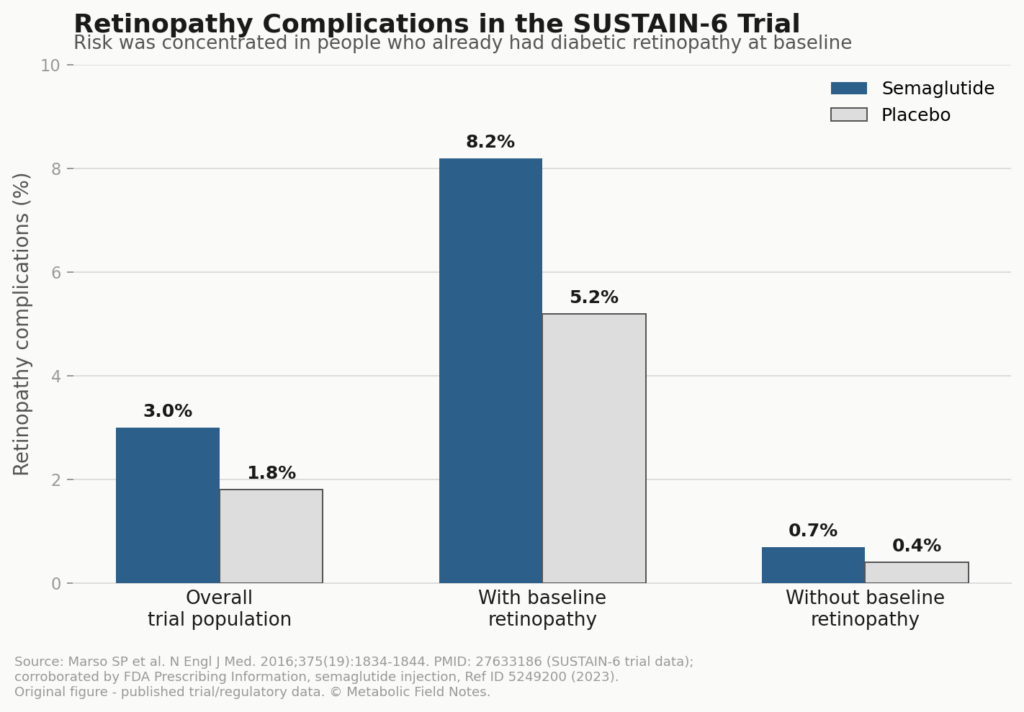
The FDA’s prescribing information states the likely reason plainly: rapid improvement in glucose control has been associated with a temporary worsening of existing diabetic retinopathy.[1] This is not unique to one medication. A 2022 meta-analysis of GLP-1 trials with confirmed cardiovascular benefit found a similar early-worsening pattern across the drug class as a whole (odds ratio 1.23), not one specific brand.[3] It reflects how quickly the treatment is working on blood sugar, not a defect particular to any single product.
That said, the evidence picture is not uniform across the full body of literature. More recent reviews examining a broader range of GLP-1 trials – beyond the cardiovascular-benefit-enriched datasets – have not found conclusive evidence of a class-wide increase in diabetic retinopathy risk. The worsening signal observed in trials like SUSTAIN-6 appears concentrated in a high-risk subgroup rather than a generalizable finding across all GLP-1 users.
People most likely to see this effect share three features: existing retinopathy, a sharp early drop in HbA1c, and long-standing diabetes with prior inconsistent control.[4] If none of those describe you, the risk here is low – the mechanism above, not this one, explains most GLP-1 blurry vision.
The Two Patterns Worth Telling Apart
Two different things can make vision blurry on GLP-1 medication, and they are not the same event wearing two names.
Pattern one is the glucose-shift blurriness described above: gradual over days, affects both eyes evenly, no pain, and it settles on its own as blood sugar stabilizes.
Pattern two is retinopathy-related change: more likely with diagnosed retinopathy, a sharp HbA1c drop after starting treatment, or many years of diabetes with inconsistent control. It does not always announce itself with obvious early symptoms, which is why a dilated eye exam – not symptom-watching alone – is how it actually gets caught.[4]
There is a third, much rarer possibility worth naming so you do not mistake it for either of the above: a sudden, painless loss of vision in one eye from reduced blood flow to the optic nerve, called NAION. Recent safety reviews describe it as a statistically significant but very low absolute risk signal in some datasets.[5] It gets its own full treatment elsewhere on this site – the short version is that it is sudden and one-sided, which is exactly what makes it different from the gradual, both-eyes pattern most people experience.
A Caution, Stated Plainly
A few things worth being direct about.
The FDA’s own label notes that the effect of long-term glycemic control with semaglutide on retinopathy complications has not been studied[1] – meaning the two-year worsening signal is better understood than what happens over five or ten years of treatment. Most of the supporting trial evidence involves people with type 2 diabetes and elevated cardiovascular risk; how fully it generalizes to every GLP-1 user, including people without diabetes using it for other reasons, is not settled.
This article also cannot tell you which pattern your own blurriness fits. That takes an actual exam, not a checklist read at home. And none of this is a reason to pause or stop a prescribed GLP-1 medication on your own – unmanaged diabetes carries its own, larger risk to your eyes over time. Whether to continue, pause, or adjust treatment is a decision for your doctor, not for this article.
Signs That Need Same-Day Care
Call your doctor or seek urgent eye care the same day if you notice:
- Sudden vision loss, or a dark curtain or shadow moving across part of your vision – especially in one eye.
- A sudden shower of new floaters, or new flashes of light.
- Severe eye pain, or vision loss with a headache.
- Vision loss that came on suddenly, even if it seems to partly clear afterward.
None of these match the routine, gradual, both-eyes blurriness described earlier – and that contrast (sudden vs. gradual, one eye vs. both, painful vs. painless) is the fastest way to sort which category you are in before you even reach a doctor.
Routine blurriness, by comparison, usually looks like: gradual onset over days, both eyes affected similarly, no pain, and timing that lines up with a recent dose change. That pattern is reasonable to mention at your next scheduled visit rather than treat as an emergency – though your doctor should confirm that judgment, not you alone, especially the first time it happens.
Questions to Bring to Your Eye Doctor
If you have diabetes and are starting or adjusting GLP-1 medication, a baseline ophthalmic assessment before beginning treatment is worth requesting – not just to stage any retinopathy that may already be present, but to record your current refractive error, assess for a crowded optic disc, and screen for conditions like glaucoma that may not yet be causing noticeable symptoms. That baseline makes any future comparison meaningful. Bring these questions to your ophthalmologist or physician:
- Do I have diabetic retinopathy now, and if so, what stage?
- Should I have a full baseline ophthalmic assessment before starting – covering my current refractive error, retinopathy stage, and any conditions like glaucoma that may not yet be symptomatic?
- How soon after a dose change should I schedule a follow-up eye check?
- What specific vision changes should prompt an urgent call rather than waiting for my next visit?
- Does my current blurriness fit the expected glucose-shift pattern, or does it need direct evaluation now?
The Bottom Line
Blurry vision after starting or adjusting GLP-1 medication is common, and usually temporary – blood sugar improving faster than your eyes can adjust to. But common is not certain, and the only way to know which pattern you are in is an actual exam, especially with existing retinopathy or a long history of inconsistent control.
Tracking when the blurriness started, whether it followed a dose change, and which eye is affected gives your doctor exactly what they need to sort routine from urgent quickly, instead of starting from scratch.
This article is for education only and does not replace medical advice. If you notice vision changes while using GLP-1 medication, talk to your doctor or an ophthalmologist, who can assess your personal health history, retinopathy status, and whether your symptoms need same-day evaluation.
Join the Field Notes
Metabolic Field Notes tracks the evidence as it develops, without protocol-pushing and without hype. If evidence-aware, translational science is useful to you, join the Field Notes.
REFERENCES
[1] U.S. Food and Drug Administration. Highlights of Prescribing Information: OZEMPIC (semaglutide) injection, for subcutaneous use – Section 5.3, Diabetic Retinopathy Complications. Reference ID: 5249200. https://www.accessdata.fda.gov/drugsatfda_docs/label/2023/209637s020s021lbl.pdf – Retrieved and verified this session (direct fetch of primary source document; retinopathy complication rates confirmed as quoted: 3.0% vs. 1.8% overall, 8.2% vs. 5.2% with baseline retinopathy, 0.7% vs. 0.4% without).
[2] Marso SP, Bain SC, Consoli A, et al. Semaglutide and Cardiovascular Outcomes in Patients with Type 2 Diabetes (SUSTAIN-6). N Engl J Med. 2016;375(19):1834-1844. DOI: 10.1056/NEJMoa1607141. PMID: 27633186. Retrieved and verified via PubMed this session.
[3] Yoshida Y, Joshi P, Barri S, Wang J, Corder AL, O’Connell SS, Fonseca VA. Progression of retinopathy with glucagon-like peptide-1 receptor agonists with cardiovascular benefits in type 2 diabetes – a systematic review and meta-analysis. J Diabetes Complications. 2022;36(8):108255. DOI: 10.1016/j.jdiacomp.2022.108255. PMID: 35817678. Retrieved and verified via PubMed this session.
[4] Rajagopal R, McGill JB. Novel Agents in the Management of Diabetes and Risk of Worsening Diabetic Retinopathy. Retina. 2024;44(11):1851-1859. DOI: 10.1097/IAE.0000000000004252. PMID: 39151204. Retrieved and verified via PubMed this session.
[5] Song SJ, Kim E. Glucagon-Like Peptide-1 Receptor Agonists and Ocular Outcomes: Metabolic Transition, Retinal Vulnerability, and Risk-Stratified Monitoring. J Obes Metab Syndr. 2026;35(2):164-175. DOI: 10.7570/jomes26012. PMID: 42059115. Retrieved and verified via PubMed this session.
Track your symptoms, energy, meals, and questions so your doctor visit is clearer. A tool like TRACKT makes this easy — a short daily log, helps your doctor understand exactly what you’re experiencing.