

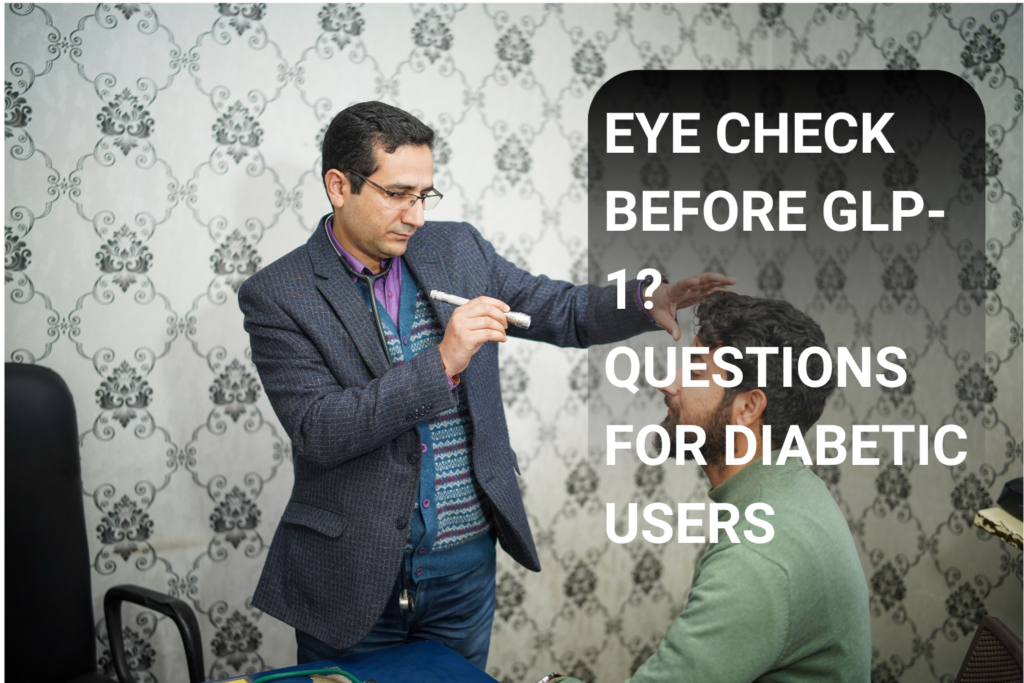
If you have diabetes and your doctor just suggested a GLP-1 medication, there is one appointment you should book before your first dose: an eye exam. Not because the medication is unsafe — but because your eyes can tell a story your bloodwork can’t.
Most people starting semaglutide or tirzepatide focus on nausea, injection technique, or how fast the weight will come off. Eye health rarely makes the checklist. But for anyone with diabetes, especially longer-standing diabetes or a history of retinopathy, a baseline eye exam changes what your doctor watches for in the following months — and it is a five-minute conversation that is easy to skip in a rushed appointment.
This is a practical guide to the exact questions worth asking, before the first injection, not after a symptom appears.
Why the Timing of the Eye Exam Matters
The reason eye screening comes up specifically with GLP-1 medications is not random. The SUSTAIN-6 trial, which tested semaglutide against placebo in people with type 2 diabetes, found a real increase in diabetic retinopathy complications in the semaglutide group.[1] But the story underneath that headline number is more specific and more useful.
The excess risk was not spread evenly across everyone in the trial. It was concentrated almost entirely in people who already had retinopathy at baseline, had poor blood sugar control going in, and then experienced a large, fast drop in HbA1c after starting treatment.[1] A drop greater than 2% within two months was linked to a meaningfully higher chance of retinopathy worsening — a threshold first documented in the Diabetes Control and Complications Trial (DCCT) and observed again in SUSTAIN-6.[1,4] People without existing retinopathy, or whose blood sugar improved more gradually, did not carry the same risk.
That is the actual mechanism worth understanding: a sudden, aggressive drop in blood sugar — documented across multiple trials, not just SUSTAIN-6 — can paradoxically worsen severe preexisting retinopathy due to osmotic shifts and a transient rise in vascular endothelial growth factor (VEGF). It is not the drug attacking the eye directly. It is the speed of glucose improvement outpacing what already-fragile retinal blood vessels can adjust to. In people with severe preexisting retinopathy, more than 10% can experience early worsening through this mechanism.[4]
Check with your doctor: has your retina ever been examined, and do you know your current HbA1c?
What the Eye Exam Actually Checks For
A baseline eye exam before starting a GLP-1 is not a vision test with a letter chart. It is a dilated, comprehensive look at the back of the eye — the retina, the optic nerve, and the blood vessels feeding them.
Professional eye-care bodies have converged on this as standard practice. The American Academy of Ophthalmology and the North American Neuro-Ophthalmology Society issued a joint consensus statement recommending a comprehensive dilated eye exam within the 12 months before starting a GLP-1 receptor agonist, with a baseline exam at treatment start for anyone who has not had one recently.[2] The American Optometric Association’s clinical report on GLP-1 medications and ocular health echoes this: a baseline in-person dilated fundus exam, with photography or optical coherence tomography (OCT) imaging where available, gives your eye doctor a documented “before” picture to compare against later.[3]
This baseline matters for two separate reasons, not one:
- It tells your doctor whether retinopathy already exists, so they know if you are in the higher-risk group SUSTAIN-6 identified
- It creates a documented reference point, so if anything changes in your vision later, there is something concrete to compare it to — not just your memory of “things seemed fine before”
How often your eyes are checked after starting treatment depends on what that baseline exam finds. For someone with no retinopathy, annual follow-up remains the standard. Mild non-proliferative diabetic retinopathy typically calls for a repeat exam within nine months. Severe or proliferative retinopathy requires follow-up every two to three months — and may need immediate intervention in the form of laser treatment or anti-VEGF injections, independent of any GLP-1 medication decisions.[4]
Ask your eye doctor directly: can you photograph or image the retina today, so we have a clear baseline on file?
Questions Worth Bringing to the Appointment
A rushed primary care visit is not the place to work through this list in your head. Bring it written down.
Before starting the medication:
- Have I had a dilated eye exam in the last 12 months? If not, can one be scheduled before or right at treatment start?
- Do I currently have diabetic retinopathy, and if so, what stage?
- What is my current HbA1c, and how quickly does my doctor expect it to change on this medication?
During the first few months:
- Given my retinopathy status and HbA1c, do I need more frequent eye checks than the standard annual schedule?
- What specific vision changes should prompt a call to my eye doctor rather than waiting for the next scheduled visit?
- If my blood sugar drops quickly, will my care team adjust monitoring, or is that something I need to bring up myself?
A separate, distinct question — not to be confused with retinopathy:
- Regulatory reviewers have also flagged a very rare, unrelated eye condition called NAION (non-arteritic anterior ischemic optic neuropathy) as a possible signal with GLP-1 medications — what would sudden vision loss in one eye mean, and how urgently should I act on it?
These are two different mechanisms — gradual retinopathy change tied to glucose speed, versus a rare, sudden-onset optic nerve event — and conflating them muddies the conversation with your doctor. Keep them as separate line items.
What This Does Not Mean for Your Treatment Decision
None of this is a reason to avoid a GLP-1 medication if your doctor has recommended one. The same body of evidence that flagged the retinopathy signal in SUSTAIN-6 also underlies the broader consensus that, for most patients, the metabolic and cardiovascular benefits of GLP-1 therapy outweigh the early retinopathy risk — particularly because the risk is concentrated in an identifiable subgroup, not universal.
What changes is not whether you take the medication. What changes is the monitoring plan around it — and that plan only gets built if the baseline conversation happens first. A five-minute question at your prescribing visit, or one dilated exam booked before your first dose, is what turns “we’ll keep an eye on it” from a vague reassurance into an actual plan with a comparison point.
Track your symptoms, energy, meals, and questions so your doctor visit is clearer. A tool like TRACKT makes this easy — a short daily log, helps your doctor understand exactly what you’re experiencing.
Track What Matters, Not Just What’s Loud
Eye health is easy to deprioritize because it rarely produces a symptom until something has already progressed. Blood sugar numbers, weight, and injection-day side effects are loud and immediate. Retinal changes are quiet until they aren’t.
Talk to your doctor about your personal risk profile before starting, and don’t skip the baseline exam because nothing feels wrong yet. Track your symptoms, energy, meals, and questions so your doctor visit is clearer — a documented baseline is worth more than a recalled impression, for your eyes as much as anything else.
This content is for informational and educational purposes only. It does not constitute medical advice, diagnosis, or treatment. Always consult a qualified healthcare professional before making changes to your medication, diet, or health routine.
Join the Field Notes
Metabolic Field Notes tracks the evidence as it develops, without protocol-pushing and without hype. If evidence-aware, translational science is useful to you, join the Field Notes.
References
1. Vilsboll T, Bain SC, Leiter LA, et al. Semaglutide, reduction in glycated haemoglobin and the risk of diabetic retinopathy. Diabetes Obes Metab. 2018;20(4):889-897. PMID: 29178519.
2. American Academy of Ophthalmology and North American Neuro-Ophthalmology Society. Glucagon-Like Peptide-1 Receptor Agonists and the Risk of Non-Arteritic Anterior Ischemic Optic Neuropathy: A Consensus Statement by NANOS and the American Academy of Ophthalmology. 2025. Available at aao.org.
3. American Optometric Association. Glucagon-like Peptide-1 Receptor Agonists (GLP-1RAs) and Ocular Health: Guidance for Optometric Practice. Clinical Report, presented at Optometry’s Meeting 2025.
4. The Diabetes Control and Complications Trial Research Group. The effect of intensive treatment of diabetes on the development and progression of long-term complications in insulin-dependent diabetes mellitus. N Engl J Med. 1993;329(14):977-986. PMID: 8366922.