

Behavioral interventions for obesity are the part of the evidence base that practitioners often describe but rarely implement with enough intensity to actually work. The U.S. Preventive Services Task Force (USPSTF) recommends 12 or more sessions in the first year. Most patients see far fewer. The WHO, in its December 2025 guidelines, recommended behavioral counseling before initiating GLP-1 therapy and conditionally alongside it. Most patients starting a GLP-1 drug have had no structured behavioral support at all.
The gap is not a failure of evidence. The evidence-based behavioural data on CBT for obesity is consistent and reasonably strong. The gap is a failure of delivery – of sequencing, of intensity, of making the skills concrete enough to be used. CBT-FIRE is a structured CBT framework which aims to bridge this gap.
CBT-FIRE applies cognitive-behavioral principles to obesity management in a way that is practical, sequenced, and oriented toward building automatic habits rather than relying on sustained willpower. The four stages – Focus, Identify, Reshape, Embed – map directly onto the established CBT competencies for weight management and can be applied across individual therapy, group programs, or coached digital delivery.
What CBT Adds to Obesity Treatment
Cognitive behavioral therapy for obesity works through two distinct pathways. The first changes the thoughts, beliefs, and interpretations about food, body, and self that maintain maladaptive eating patterns and thought processes. The second reshapes behavioral routines that sustain excess weight largely independent of conscious decision-making. Thus it aims to achieve a curative and preventive strategy for the individual to adopt.
A 2024 network meta-analysis found CBT was the most effective intervention for weight loss against a no-treatment comparator, outperforming behavioral therapy, usual care, and minimal care. The average weight loss difference in CBT arms was 1.70 kg compared to comparators. That number sounds modest but represents averages across heterogeneous populations receiving variable session intensity, not the effect in patients receiving the full 12+ session USPSTF-recommended dose.
Third-wave CBT approaches – acceptance and commitment therapy (ACT) in particular – showed increasing advantages over time: effect sizes of -0.09 at end of treatment, -0.17 at 12 months, and -0.21 at 24 months. The pattern suggests the cognitive skills built in third-wave CBT compound over time in a way that earlier, purely behavioral approaches do not.
Digital programs built on CBT, ACT, and dialectical behavior therapy (DBT) principles have demonstrated that these frameworks can be delivered at scale with meaningful, sustained outcomes – a signal that the barrier to access is logistical, not methodological.
The Four Stages of CBT-FIRE
F – Focus
The first task is narrowing attention to the specific behaviors that are driving weight gain, rather than attempting to overhaul everything simultaneously. Behavioral assessment maps the landscape: what is being eaten, when, in response to which emotional or situational triggers, and with what immediate and downstream consequences.
Most patients know they eat too much. They do not know which specific behaviors carry the most caloric weight. A two-week behavioral diary, reviewed collaboratively, typically reveals two or three high-impact patterns worth targeting – late-night eating after work stress, portion distortion in social settings, mindless eating while watching screens – rather than the diffuse, unaddressable sense that “everything is wrong.” The key strategy to note is that targeting two behaviors with high precision produces more durable change than addressing ten behaviors superficially.
I – Identify
Once specific behaviors are mapped, the cognitive component begins: identifying the automatic thoughts, beliefs, and emotional states that precede those behaviors. This is where CBT diverges most sharply from simple behavioral advice and drives towards cognitive restructuring for maladaptive cognitive components linked to eating.
Cognitive distortions involve negative thinking patterns that aren’t based on fact or reality. Cognitive distortions in obesity management are well-characterized in the clinical literature. All-or-nothing thinking (“I ate one biscuit so the whole day is ruined”) is among the most clinically consequential because it converts a minor deviation into a full behavioral collapse – the “what the hell effect” documented in decades of weight management research. Permission-giving thoughts (“I deserve this, I’ve had a hard week”) appear reliably in emotional eating sequences. Catastrophising around social eating events drives avoidance patterns that disrupt both social function and dietary adherence.
The goal of the Identify stage is not to eliminate these thoughts – they are automatic and will occur. This stage creates first awareness of these thought patterns as and when they occur, and then the goal is to insert a gap between thought and action: a patient who can notice “there’s the all-or-nothing pattern again” has an intervention point. A patient who does not recognise the pattern has none.
R – Reshape
With specific behaviors targeted and their cognitive antecedents mapped, the third stage introduces behavioral experiments and cognitive restructuring – the active skill-building components of the framework.
Behavioral experiments test whether feared outcomes actually occur. A patient who avoids eating at a family gathering because they assume judgment will follow discovers that the assumption was inaccurate. Repeated testing of that assumption weakens its grip on behavior. Cognitive restructuring replaces rigid self-evaluative statements with more functional alternatives – not the hollow optimism of “I love salads,” but the more workable “one deviation does not determine the week.”
Environmental restructuring is part of the Reshape stage and is often underrated. Keeping fruit visible on the counter, removing trigger foods from the home, planning a route that avoids the fast food outlet – these are not willpower interventions. They are architecture interventions. They reduce the number of active decisions the brain has to make, which matters because decision fatigue is real and predictable.
E – Embed
The final stage – often underweighted in clinical delivery – focuses on moving new behavioral patterns from conscious effortful choices to background habits that require no active decision to maintain. The aim is conscious repetition of skills gained to allow them to change to habitual usage of skills and to unconscious usage of skills which run as if they are on auto-pilot. This is key to prevent relapse.
Habit research shows that automaticity develops through consistent repetition in stable contexts. The same behavior, in the same situational context, repeated enough times, eventually stops requiring a deliberate decision. A 2017 randomised trial of habit-based weight management advice (the “10 Top Tips” trial) found that patients receiving habit-formation instructions lost significantly more weight at three months than those receiving usual care – without additional therapy sessions.
The Embed stage also includes structured relapse prevention: identifying the high-risk situations most likely to undermine maintenance, rehearsing cognitive and behavioral responses in advance, and reframing lapses as expected events rather than evidence of personal failure. This framing shift – from “relapse = failure” to “relapse = expected and recoverable” – is one of the most durable cognitive moves in obesity management and one of the clearest differentiators between patients who maintain and those who do not.
CBT-FIRE Alongside GLP-1 Therapy
The WHO’s conditional recommendation to use behavioral counseling alongside GLP-1 therapy reflects a practical reality: these drugs create a window of reduced appetite and food reward in which new behavioral patterns can be established with reduced effort. That window is not permanent, and GLP-1 drugs do not reprogram eating habits – they provide a metabolic environment in which CBT can gain traction more easily. GLP-1 therapy can do the biological heavy lifting regarding obesity management and CBT-FIRE can do the psychological heavy lifting, thereby providing obesity management linked to overall sustainable wellness.
Patients who use GLP-1 drugs without behavioral support tend to return to previous eating patterns when doses are reduced or discontinued. The behavioral literature on post-treatment regain is consistent on this point. Patients who use the GLP-1 window to develop genuine habit automaticity carry something forward regardless of what happens to their drug status. CBT-FIRE is designed to extract the maximum cognitive and behavioral benefit from that window while it is open.
Cautions
The CBT for obesity evidence base is predominantly from Western populations, with most trials conducted in the United States, United Kingdom, and Northern Europe. Whether the specific cognitive distortions, social eating norms, and environmental triggers that CBT-FIRE targets apply uniformly across South Asian contexts is an open question. Clinicians working with South Asian patients may find the Identify stage requires different content and contexts – family food practices, festive eating cycles, and cultural scripts around body weight and hospitality operate differently than in the populations from which standard CBT obesity protocols were developed.
CBT-FIRE requires skilled delivery to be effective at the standard intensity. A self-guided version can produce modest benefits but is unlikely to match outcomes from a trained CBT practitioner delivering the full protocol.
Join the Field Notes
Metabolic Field Notes tracks the evidence as it develops, without protocol-pushing and without hype. If evidence-aware, translational science is useful to you, join the Field Notes.
REFERENCES
- World Health Organization. WHO guideline on the use of glucagon-like peptide-1 (GLP-1) therapies for the treatment of obesity in adults. Published December 1, 2025. https://www.who.int/news/item/01-12-2025-who-issues-global-guideline-on-the-use-of-glp-1-medicines-in-treating-obesity
- Cha JY, Kim SY, Lim YW, Choi KH, Shin IS. Comparative Effectiveness of Cognitive Behavioral Therapy and Behavioral Therapy in Obesity: A Systematic Review and Network Meta-Analysis. J Clin Psychol Med Settings. 2025 Mar;32(1):96-110. Epub 2024 Jan 29. doi:10.1007/s10880-023-10000-6. PMID: 38285378
- Lawlor ER, Islam N, Bates CR, et al. Third-wave cognitive behaviour therapies for weight management: A systematic review and network meta-analysis. Obes Rev. 2020 Jul;21(7):e13013. doi:10.1111/obr.13013. PMID: 32181957. PMC: PMC7379202
- Beeken RJ, Leurent B, Vickerstaff V, et al. A brief intervention for weight control based on habit-formation theory delivered through primary care: results from a randomised controlled trial. Int J Obes (Lond). 2017 Feb;41(2):246-254. PMC: PMC5300101
- US Preventive Services Task Force. Weight Loss to Prevent Obesity-Related Morbidity and Mortality in Adults: Behavioral Interventions. USPSTF Recommendation Statement. JAMA. 2018;320(11):1163-1171. doi:10.1001/jama.2018.13022
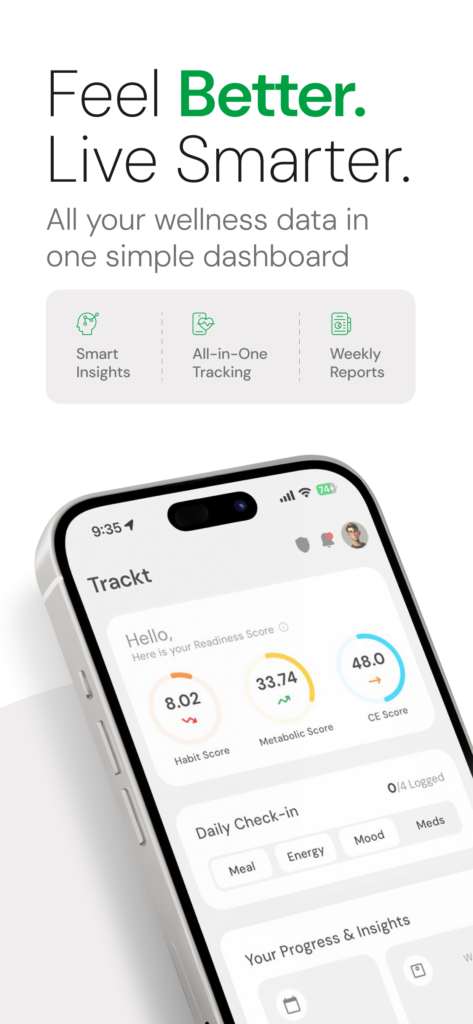
Track your symptoms, energy, meals, and questions so your doctor visit is clearer. A tool like TRACKT makes this easy — a short daily log, helps your doctor understand exactly what you’re experiencing.
Medical Disclaimer: The content on this blog is for informational and educational purposes only and does not constitute professional medical advice, diagnosis, or treatment. Always seek the advice of your physician or other qualified health provider with any questions you may have regarding a medical condition.