

The scale on GLP-1 medication can move fast. Not all of that loss is fat.
When body weight drops quickly, the body loses a mix of fat mass, water, and lean tissue — and while GLP-1 medications are effective at reducing fat, lean mass can also decline as part of that total. This does not mean the medication is damaging muscle. It means the body needs a clear signal that this tissue is still being used and still worth keeping.
Strength training is that signal.
Why muscle needs attention during GLP-1 weight loss
Understanding the broader picture of muscle loss, appetite, and nausea on GLP-1s helps explain why a deliberate approach to muscle preservation matters from the start. In the STEP 1 body-composition subset, semaglutide reduced both fat mass and total lean body mass over 68 weeks, while the lean-mass-to-fat-mass ratio improved because fat mass fell more. That distinction matters, but it does not mean lean mass loss is harmless or irrelevant.
A smaller body does not automatically mean a weaker one. The risk is that rapid weight loss paired with low protein intake, reduced movement, and no resistance training gives the body very little reason to hold on to muscle — and skeletal muscle is not just a shape issue. It supports glucose uptake, posture, balance, joint stability, and daily energy output, all of which matter more as body composition shifts quickly. For someone using a GLP-1 medication, the goal is not simply to weigh less but to lose weight while keeping as much function as possible. The question worth asking is not whether to exercise more, but what signal the body needs each week to keep strength.
Start with two full-body sessions per week
Two non-consecutive strength sessions per week is enough to create a preservation signal without overwhelming a body already adapting to reduced intake. The structure should cover five basic movement patterns:
- Squat pattern – chair squat, goblet squat, leg press
- Hinge pattern – hip bridge, Romanian deadlift, cable pull-through
- Push pattern – wall push-up, dumbbell press, machine chest press
- Pull pattern – band row, cable row, dumbbell row
- Carry or core pattern – farmer carry, dead bug, side plank
During the first two weeks, one to two sets of each movement is plenty. Choose a load that feels challenging but controlled, finishing each set with the sense that two or three more good repetitions were still available. That margin matters specifically for GLP-1 users, who often have days when appetite, nausea, sleep quality, or hydration shifts how the body responds to effort. On those days, forcing intensity works against the goal. The appointment with the movement stays — the load adjusts.
Consistency beats heroic effort.
Use the 8 to 12 repetition rule as your anchor
For most beginners, 8 to 12 controlled repetitions per exercise is a practical starting range — heavy enough to ask the muscle to work, light enough to build technique without turning every set into a test. The rule is straightforward: if 8 clean reps are not possible, reduce the weight; if 12 clean reps feel easy, increase it slightly next time; and if form changes at any point, the set is over regardless of the count.
This is progressive overload in plain language. The body adapts when the challenge gradually increases, and that increase does not have to be dramatic — one more repetition, a slightly heavier weight, one extra set, or better range of motion all count. Soreness can appear at the beginning, but it is not the target and should not be chased. A good session leaves the body feeling used, not punished, and recoverable enough to return in two or three days.
Match training to GLP-1 realities
A GLP-1 exercise plan should respect the lived experience of the medication. For some people this is unremarkable; for others it means managing nausea, constipation, fatigue, reduced appetite, or lower overall meal volume at unpredictable intervals. Planning around those realities is not a compromise — it is the actual strategy.
Training after some food, when possible, tends to reduce lightheadedness during the session. Hydrating earlier in the day rather than catching up in the hour before training helps as well, and heavy sessions immediately after a large meal are worth avoiding if gastric emptying feels slow. On days when the body is clearly running low, the minimum effective session is enough:
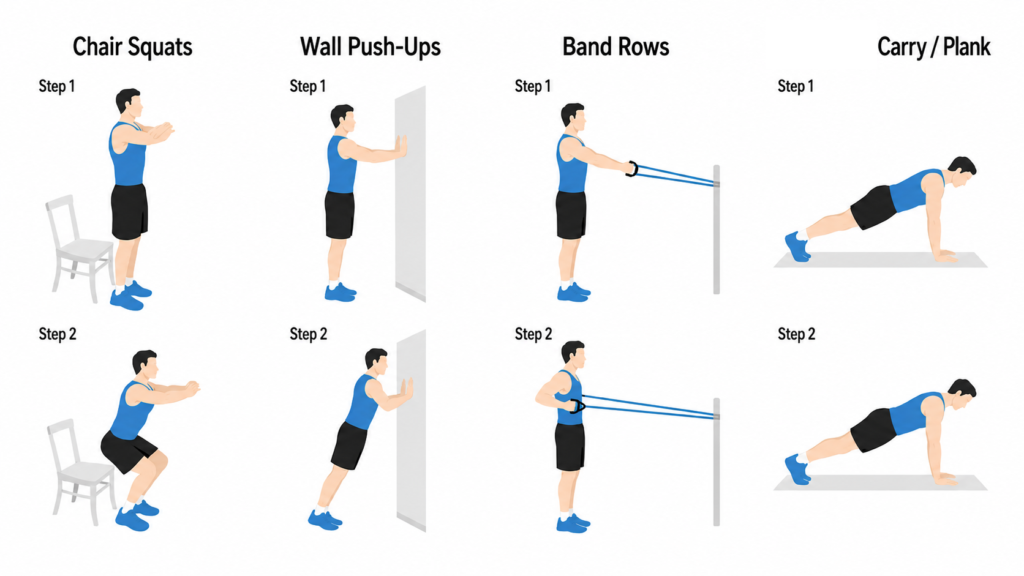
- 5 chair squats
- 5 wall push-ups
- 10 band rows
- 20-second carry or plank
- Repeat once if stable
This is not a failure version of the workout. It is the maintenance version — and keeping that distinction clear matters because most people stop training when they believe every session must be complete. During GLP-1 treatment, the standard is simply to keep the muscle signal alive while the body changes.
Protein and strength training work together on GLP-1
Strength training tells the body to keep muscle, but protein provides the raw material to do so. The two work as a pair, and the practical challenge on GLP-1 medication is that appetite may be too low to make adequate protein intake automatic. Large meals often feel uncomfortable, greasy foods may be off-putting, and many users drift into low-protein eating simply because smaller, lighter meals are easier to manage.
The answer is not perfection but structure. Try anchoring each day to two or three protein moments:
- Greek yogurt, eggs, tofu, paneer, fish, chicken, lentils, or protein-rich smoothies
- A protein-first breakfast if mornings are the easier window
- Smaller protein portions at lunch and dinner, even on low-appetite days
- A simple fallback option — a boiled egg, a glass of milk, a handful of edamame — for the days when nothing sounds appealing
Protein needs vary by body size, medical status, kidney function, age, and training level, and anyone with kidney disease, complex medical conditions, or an existing clinician-provided nutrition plan should follow that guidance rather than general advice. For most readers, though, the key habit is straightforward: do not let reduced appetite quietly become low protein combined with no strength training. That pairing is the one most likely to undermine the weight-loss outcome.
Track strength, not just scale weight
The scale is loud, and on GLP-1 medication it often moves quickly. Strength is quieter and builds more slowly — which is why tracking it requires some intention. A data-driven approach to GLP-1 progress makes the case for measuring signals the scale cannot capture, and for strength the most useful ones are functional rather than numeric:
- Can you stand from a chair more easily than last month?
- Can you carry groceries without stopping?
- Are stairs less effortful than they were?
- Are your working weights in training stable or gradually increasing?
- Is your grip stronger?
- Do you feel steadier in daily movement?
These are function metrics, not vanity metrics. A GLP-1 journey that lowers weight while preserving strength produces a body that is not only smaller but more capable — and that outcome requires paying attention to both sides of the equation.
A simple 4-week starter plan
For anyone new to strength training or returning after a long break, the following structure provides a repeatable entry point.
Week 1
Two sessions. One set per movement. Keep the load easy to moderate and focus on learning the pattern rather than testing limits.
Week 2
Two sessions. Add a second set to two of the five movements. Keep two or three reps in reserve on every set.
Week 3
Two sessions. Add a second set to all movements if recovery has been good, and increase the load slightly on one or two exercises.
Week 4
Two sessions with the same exercises. The goal is to improve one variable — one additional rep, slightly cleaner form, or a small weight increase — and nothing more.
After four weeks, the choice is whether to stay at two sessions or move to three. Two days done consistently is more valuable than three days done sporadically. The best plan is the one that fits real life, not the one that looks ambitious for a week before disappearing.
A note on evidence and individual variation
The guidance here is drawn from general exercise science and adapted for the GLP-1 context. Direct RCT evidence on specific resistance training protocols in GLP-1 users remains limited as of 2026, and the STEP 1 body-composition data referenced throughout is from an exploratory analysis rather than a primary endpoint. Those limitations are worth naming because they shape how confidently any specific recommendation can be made.
In practice, this means a few guardrails apply before starting:
- If you have diabetes, cardiovascular disease, joint conditions, or a complex medical history, speak with your clinician before beginning strength training.
- GLP-1 users with active nausea or significant fatigue may need to wait for a more stable window before adding load.
- Dizziness, lightheadedness, or unusual weakness during a session are signals to stop and reassess caloric and hydration status before continuing.
- The protein guidance in this article is general and not a substitute for individualized nutrition support from a dietitian or clinician.
None of this makes strength training inadvisable. It makes it worth approaching with care rather than urgency.
The field note
GLP-1 medications shift the food environment inside the body — appetite drops, meals shrink, and weight may move faster than expected. That speed can feel like progress, but it also creates a gap between what the scale shows and what the body is actually holding on to.
Strength training fills part of that gap. It tells the body that muscle is still needed and gives weight loss a direction beyond a number. These are the metabolic movement signals the body still responds to, even under the pressure of rapid weight change.
The goal is not to become a lifter. It is to remain strong while becoming lighter — and that is a goal a few sessions a week, done consistently over time, is genuinely capable of supporting.
Join the Field Notes
Metabolic Field Notes tracks the evidence as it develops, without protocol-pushing and without hype. If evidence-aware, translational science is useful to you, join the Field Notes.
REFERENCES
[1] Wilding JPH, Batterham RL, Calanna S, et al. Once-Weekly Semaglutide in Adults with Overweight or Obesity. New England Journal of Medicine. 2021;384:989-1002. DOI: 10.1056/NEJMoa2032183.
[2] Wilding JPH, Batterham RL, Davies M, et al. Impact of Semaglutide on Body Composition in Adults With Overweight or Obesity: Exploratory Analysis of the STEP 1 Study. Journal of the Endocrine Society. 2021;5(Suppl 1):A16-A17.
[3] ClinicalTrials.gov. STEP 1: Research Study Investigating How Well Semaglutide Works in People Suffering From Overweight or Obesity. NCT03548935.
[4] Tinsley GM, Harty PS, Stratton MT, et al. Preservation of lean soft tissue during weight loss induced by glucagon-like peptide-1 receptor agonists and dual agonists. 2025. [Citation requires full verification before publication]
[5] American College of Sports Medicine. Physical Activity Guidelines and Resistance Training Guidance. Adults should perform activities that maintain or increase muscular strength and endurance at least two days per week.
Medical Disclaimer: The content on this blog is for informational and educational purposes only and does not constitute professional medical advice, diagnosis, or treatment. Always seek the advice of your physician or other qualified health provider with any questions you may have regarding a medical condition.


Pingback: GLP-1 and Inflammation: What the Research Actually Shows
Pingback: GLP-1 Side Effects: Normal, Serious, and What to Track