

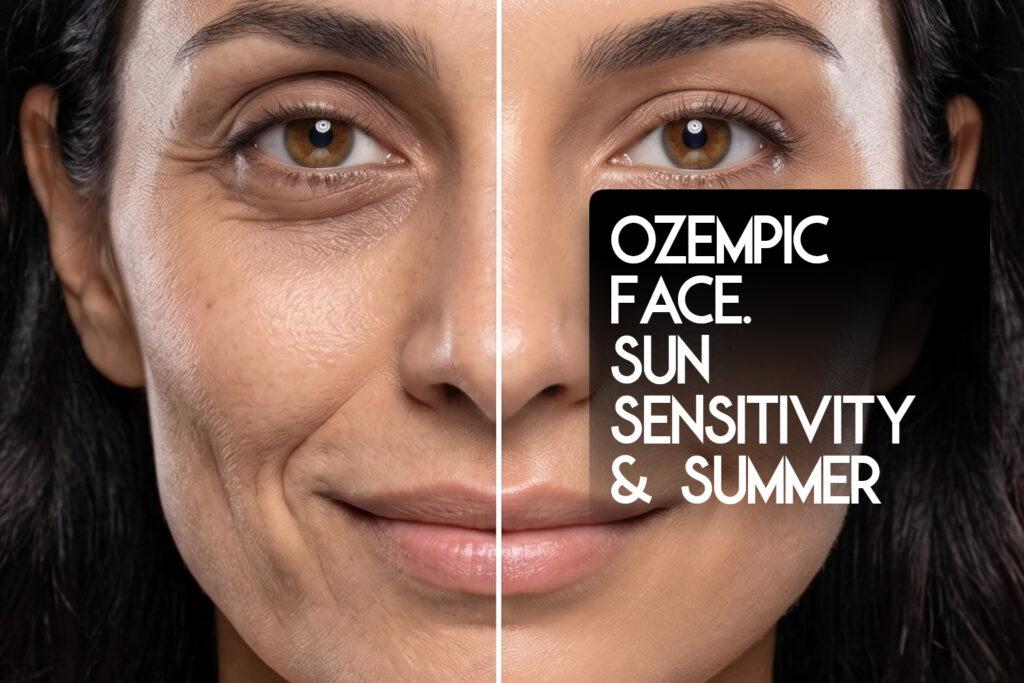
The scale had been moving for three months. What nobody warned her about was the mirror.
She had started semaglutide in January. By spring, down 28 pounds, clothes fitting differently, feeling better on stairs. Then one afternoon in April — maybe it was the bathroom lighting, or the angle — she noticed it. Her cheeks looked hollower. The space beneath her eyes had a shadow that wasn’t there before. She looked, in a way she couldn’t quite name, older.
This has a name. And it has a biology that most prescribers don’t have time to explain.
“Ozempic Face” entered the cultural conversation as a celebrity gossip item. Gaunt. Haggard. The look of someone who lost weight too fast. But stripped of the tabloid framing, it describes something real: a pattern of facial change that emerges when subcutaneous fat is lost faster than skin can adapt. It doesn’t only affect people on GLP-1 medications. It happens with any significant rapid weight loss. GLP-1 medications have simply brought it to wider attention because of how effectively they produce results.
This summer, there’s a second variable entering the equation: heat, UV exposure, and what both do to skin that’s already under metabolic stress.
The mirror moment nobody warned you about
Maria had been on tirzepatide for four months when she started noticing the change. Not suddenly — skin doesn’t usually announce itself. It was cumulative. A gradual hollowing at the temples. Cheeks that used to be fuller now with a slight concavity she didn’t recognize. The lines beside her mouth were deeper.
She wasn’t imagining it.
The human face is scaffolded by discrete compartments of subcutaneous fat — cushions that sit just beneath the skin’s surface and give the face its volume, softness, and youthful architecture. There are fat pads at the cheeks, temples, below the eyes, around the jaw. These aren’t random deposits. They’re structural. When they’re present and full, the skin above them looks supported and taut. When they thin, the skin can’t hold its former position.
Rapid weight loss depletes these compartments. The scale goes down, and so does the support structure beneath your face.
This isn’t a drug effect, exactly. It’s a geometry problem. The medication created conditions for faster fat loss than the body would typically achieve on its own. The face responded to that loss, as it does for anyone losing significant weight quickly. The skin, which takes longer to contract and remodel than fat takes to disappear, is left with less beneath it than it was built around.
What makes this feel jarring is the asymmetry. The body changes fast. The skin adjusts slowly.
How facial fat works — and why it leaves first
The subcutaneous fat beneath your facial skin isn’t stored there the way fat is stored around organs or thighs. It’s organized into named anatomical compartments — the malar fat pad, the nasolabial fat, the buccal fat pad, the periorbital compartments — each one a discrete structural unit with its own blood supply and metabolic behavior.
When the body enters a significant caloric deficit, it doesn’t selectively drain one compartment first. Fat loss happens throughout the body following a pattern that’s partly genetic, partly hormonal, partly responsive to energy demand. For many people, the face is among the earlier areas to show visible change, because facial fat compartments are relatively small. A modest absolute volume of fat loss — a few grams in a compartment the size of a plum — translates to visible structural change.
Think of it this way: losing an inch off your waist requires the depletion of far more adipose tissue than losing visible volume from a cheekbone. The face is a small canvas. Proportional changes register faster there.
The skin that sits above these compartments has its own timeline. Collagen and elastin — the proteins that give skin its structure and spring — take months to years to remodel. They don’t contract the moment the fat beneath them thins. So there’s a lag. The structure retreats. The skin takes longer to follow.
This lag is where “Ozempic Face” lives. It’s the gap between how fast the fat left and how slowly the skin adapted.
Summer turns up the exposure
Here’s where the season matters.
Skin that has lost subcutaneous support is thinner — not in terms of the dermis itself, but in the total layered structure from the surface down to the deeper tissue. Thinner structure means less built-in insulation from UV radiation. The protective cushion that once absorbed and scattered environmental stress is diminished.
GLP-1 medications add a second factor that most patients don’t anticipate: thirst suppression. GLP-1 receptors are present throughout the hypothalamus, which regulates both appetite and thirst signaling. Many people on semaglutide or tirzepatide report that they simply forget to drink water. Not because they’re busy — because the signal that would normally prompt them isn’t arriving with the same urgency.
Chronic mild dehydration affects the skin barrier. The stratum corneum — the outermost layer of skin — depends on adequate water content to maintain its protective function. When it’s dehydrated, the barrier becomes less effective: more reactive, more prone to inflammation, more vulnerable to UV-induced damage.
Summer compounds all of this. Heat drives up circulation to the skin’s surface. UV intensity increases. Sweat accelerates fluid loss. For someone on a GLP-1 medication who isn’t actively managing their fluid intake, summer is the season where these factors converge into something visible — faster burning, more redness, skin that reacts where it didn’t before.
What your skin actually needs right now
None of this requires stopping medication or managing a complication. It requires a few deliberate adjustments to a routine that most people haven’t thought to make.
Sun protection, non-negotiable. Broad-spectrum SPF 30 or higher, applied every two hours during outdoor exposure. This advice becomes more important when the skin’s own protective architecture has thinned. A hat with a brim covers what sunscreen misses on the scalp and hairline. UV-protective fabrics for extended outdoor time aren’t excessive; they’re practical.
Active hydration. Don’t rely on thirst to tell you when to drink. Set a floor — most adults need at least eight cups of water daily, more in heat or with physical activity. If you’re on a GLP-1 medication, assume your thirst signal is running quiet, and build water intake into your routine the same way you’d schedule a dose. A 32-ounce water bottle finished twice a day is a useful anchor.
Protein and its co-factors. Collagen is a protein, synthesized from amino acids that come from dietary protein. Vitamin C is a required co-factor for collagen production — without it, the enzyme that builds collagen scaffolding doesn’t function properly. Zinc plays a similar structural role in skin repair and wound healing. For GLP-1 users eating less overall, micronutrient density matters more than it did before. Prioritizing protein at each meal and getting a daily source of Vitamin C supports the skin’s ability to remodel.
Barrier support. A moisturizer with hyaluronic acid or ceramides, applied to slightly damp skin, can meaningfully improve barrier hydration. This isn’t luxury skincare — it’s functional maintenance for skin that’s working with fewer structural resources than it had six months ago.
What to approach carefully. Retinol and exfoliating acids accelerate skin turnover and increase UV sensitivity. They’re useful tools, but during summer — especially for skin that’s already more reactive — they’re best used at reduced frequency, at night, with consistent SPF the following morning.
The pace question: what the timeline of loss does to your face
One woman in an online GLP-1 community described it plainly: “I lost 35 pounds in five months and my face looks ten years older. My friend lost 30 pounds over 18 months and her face looks fine.”
This is broadly consistent with what clinicians who work with significant weight loss describe. Skin remodels continuously, but it remodels at a pace. When the loss of subcutaneous volume outstrips the skin’s remodeling rate, the gap widens. When loss is slower, the skin has more time to contract, rebuild, and track the structural changes beneath it.
This doesn’t mean faster is always worse for every individual. Genetics, baseline skin quality, age, and collagen density all affect how resilient the skin is to rapid change. Some people lose weight quickly on GLP-1 medications with minimal visible facial change. Others notice it at modest weight loss.
What it does mean is that the conversation is worth having with a prescriber — not to stop medication, but to understand the options. Some providers discuss titration patterns, or longer plateaus between dose increases, particularly for patients who are expressing concerns about pace. The goal is the same: metabolic health, sustainable over the long term. How the body gets there can be shaped.
The mirror isn’t the only measure. But it’s telling you something worth listening to.
Skin is a metabolic organ. It responds to what’s happening inside the body — the rate of fat mobilization, the adequacy of protein intake, the quality of the barrier it’s asked to maintain. “Ozempic Face” is not just a cosmetic concern. It’s a visible signal about the pace of structural change, and the skin’s capacity to keep up.
This summer, the work is modest: SPF, water, protein, time outdoors with intention rather than avoidance. Understanding that the face is adapting — like everything else is adapting — and that it needs support to do that well.
Join the Field Notes
Metabolic Field Notes tracks the evidence as it develops, without protocol-pushing and without hype. If evidence-aware, translational science is useful to you, join the Field Notes.
Medical Disclaimer: The content on this blog is for informational and educational purposes only and does not constitute professional medical advice, diagnosis, or treatment. Always seek the advice of your physician or other qualified health provider with any questions you may have regarding a medical condition.