

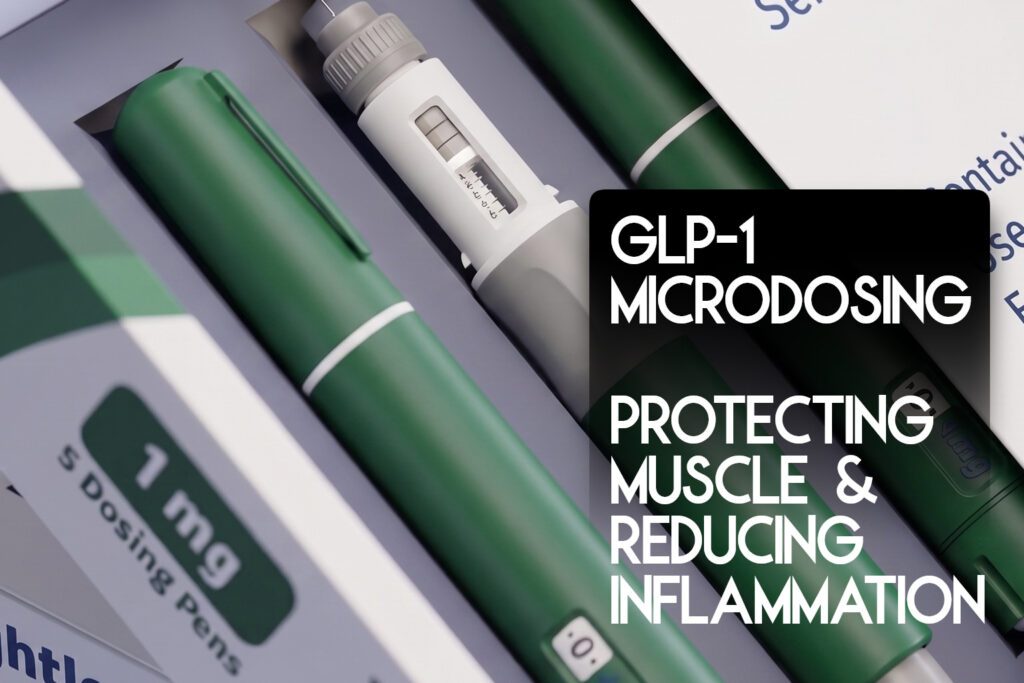
Mark is 52, six months into semaglutide, and losing weight exactly as planned. His physician is pleased. His scale is cooperating. But his trainer noticed something first.
“You look deflated,” she told him after a session. Mark laughed it off. His DEXA scan didn’t.
Fat mass: down 14%. Lean mass: also down – 9%. He’d lost nearly as much muscle as fat.
This is a story the scale can’t tell. And it’s becoming a more common one as GLP-1 prescriptions scale beyond early clinical trial populations into long-term everyday use. The protocol works. But the protocol wasn’t designed around the question Mark is now asking: what am I actually losing?
The Dose Escalation Paradox: More Isn’t Always More
The standard semaglutide pathway is well-established: 0.25 mg to start, then upward every four weeks toward a ceiling of 2.4 mg. Tirzepatide follows comparable logic. The rationale is tolerability – the gut needs time to adapt to progressively higher receptor activation before hitting maintenance levels. The evidence for that approach is solid.
The evidence for what happens to body composition during escalation is more complicated.
A 2025 review examining the full metabolic effects of semaglutide found something worth sitting with: at lower doses (0.5-1.0 mg), the relative proportion of lean body mass actually increased by approximately 3.0%, while visceral fat decreased.[1] At maximum doses, the picture shifts. Aggressive appetite suppression drives daily caloric intake down 30-40% – not because patients are choosing discipline, but because hunger signals disappear entirely. The body reads that caloric floor as famine, not as preference. Protein synthesis slows. Fast-twitch muscle fiber breakdown accelerates.
The dose escalation protocol was designed around weight loss endpoints and tolerability. Muscle preservation wasn’t a primary consideration in those original trial designs. That gap is now showing up in DEXA scans.
Where GLP-1 Receptors Live in Muscle Tissue
The standard GLP-1 story focuses on the pancreas, gut, and brain – the places where weight loss mechanics are most visible. What’s less discussed is that GLP-1 receptors are also expressed in skeletal muscle, a distribution pattern that hints at a broader metabolic role than glucose regulation and appetite suppression alone.
Research on liraglutide and semaglutide in obesity-induced muscle atrophy found that GLP-1 receptor agonists protected skeletal muscle via the SIRT1 signaling pathway – improving muscle mass, reducing atrophy markers, and restoring impaired glucose tolerance.[2] When SIRT1 was pharmacologically blocked, the protective effects disappeared, confirming the pathway is real, not incidental.
This is where the precision dosing argument becomes mechanistically coherent – and where it gets more interesting than a simple “lower dose, fewer side effects” framing.
The problem isn’t what GLP-1 does at the muscle receptor. It’s what the combination of GLP-1 plus severe caloric restriction does to the whole system. When the body enters a deep caloric deficit quickly, catabolic adaptations override local anabolic signals. Cortisol rises. mTOR – the primary regulator of muscle protein synthesis – is suppressed. Muscle becomes metabolically expensive tissue that a resource-restricted body is inclined to sacrifice. A lower dose that moderates appetite without eliminating it keeps caloric intake in a shallower deficit. The SIRT1-mediated protective signal continues. The systemic famine response doesn’t fully activate.
When Mark’s physician anchored his dose at 0.5 mg and added structured resistance training, his lean mass trajectory reversed over the following three months. Weight loss slowed. Body composition improved. “It felt like the drug was working with my body instead of dragging it,” he said. That’s not a randomized controlled trial. But it’s the kind of clinical signal that drives research questions.
The Inflammation Rebound Most Patients Don’t Expect
GLP-1s have a well-documented anti-inflammatory profile – this part is settled. Semaglutide and tirzepatide reduce C-reactive protein (CRP) and TNF-alpha in clinical trials, through weight loss, improved glycemic control, and direct effects on immune cell signaling.[3] The STEP-HFpEF trial specifically documented CRP reductions as a primary finding, reinforcing that GLP-1 receptor agonists suppress the pro-inflammatory state in ways that are clinically meaningful.[4]
The less-discussed variable is the rate of fat loss – and what happens inside adipose tissue as it shrinks.
Fat cells, particularly visceral fat cells, don’t release their contents quietly. As they shrink rapidly, they offload stored lipopolysaccharides (LPS), pro-inflammatory fatty acids, and adipokines that have been sequestered in the tissue for years. In patients losing 15-20% of body weight within twelve months, this inflammatory “unloading” can transiently elevate markers even as the long-term trajectory trends downward. The GLP-1’s anti-inflammatory effect is real. The adipose release during rapid fat loss is also real. They operate on different timescales, and at high doses, the second can temporarily outpace the first.
Microdosing, by slowing the rate of fat loss, may allow adipose tissue to release its stored inflammatory burden more gradually – reducing the peak without changing the destination.
What the Early Microdosing Observations Show
The clearest limitation of the GLP-1 microdosing literature is that it is mostly not a literature yet. No large randomized controlled trials compare standard dose escalation to intentional sub-therapeutic maintenance for body composition outcomes. What exists is observational data, case series, and mechanistic arguments – which is precisely the stage of evidence where a hypothesis lives before it becomes a protocol.
That said, a 2026 real-world study of oral semaglutide at doses approved for type 2 diabetes – lower than the obesity protocol – found that lean mass showed only a small reduction while muscle strength remained unchanged over four months.[5] The study was observational, without a comparator arm. But the direction is consistent with what lower-dose physiology would predict, and that consistency matters when the mechanism is this well-characterized.
One framework emerging from obesity medicine subspecialty practices is worth naming – as a descriptive term in clinical use, not established nomenclature in peer-reviewed literature: “dose-anchoring.” Clinicians at programs that track body composition systematically (lean mass via DEXA, muscle strength via functional testing) have begun titrating to the minimum effective dose for a patient’s specific metabolic target. Where that target is body composition rather than scale weight, the optimal dose may be considerably lower than conventional protocols suggest.
This is not the “microdosing” conversation circulating on social media, which typically involves compounded peptides and self-directed protocols outside clinical oversight. The clinical version is supervised, tied to measurable body composition metrics, and adjusted based on what the data shows. That distinction matters.
An Honest Field Notes Assessment
GLP-1 microdosing is not a validated protocol. The evidence base does not yet support recommending it as a systematic alternative to standard escalation for any specific outcome. Anyone presenting it as settled science is running ahead of the data.
What it is: a clinically coherent hypothesis with genuine mechanistic support from peer-reviewed research, and enough observational signal to warrant structured investigation. The mechanism is documented – SIRT1-mediated muscle protection,[2] dose-dependent lean mass effects,[1] and a well-evidenced anti-inflammatory case for GLP-1s at any dose.[3][4] What’s missing is the large, controlled trial asking “what is the optimal dose for body composition” rather than weight loss alone. That’s the work still ahead.
The most clarifying question isn’t “should I microdose?” – that’s a clinical decision requiring individual monitoring of body composition, inflammatory markers, and metabolic response. The more useful question is: what outcome are you actually optimizing for?
If the answer is scale weight, standard escalation protocols are well-validated and effective. If the answer includes lean mass preservation, a more graduated inflammatory trajectory, and long-term metabolic resilience – the conversation about precision dosing is worth having with a clinician who can monitor the variables that matter.
Mark is having that conversation now. The science is building toward something more individualized than one-size-fits-all escalation. That shift is already beginning in the practices paying closest attention to what the scale doesn’t measure.
The next generation of GLP-1 prescribing will likely look less like a standardized ramp and more like titration toward individual body composition targets. Lean mass and inflammatory response will probably join total weight loss as co-primary endpoints in clinical decision-making. Precision dosing is the hypothesis. The proof is being constructed. And the evidence is worth following closely.
Join the Field Notes
Metabolic Field Notes tracks the evidence as it develops, without protocol-pushing and without hype. If evidence-aware, translational science is useful to you, join the Field Notes.
REFERENCES
Based on articles retrieved from PubMed.
[1] Sokary S, Bawadi H. Exploring beyond numeric weight loss: The metabolic effects of semaglutide. Clin Nutr ESPEN. 2025;67:435-440. DOI: 10.1016/j.clnesp.2025.03.010
[2] Xiang J, Qin L, Zhong J, Xia N, Liang Y. GLP-1RA Liraglutide and Semaglutide Improves Obesity-Induced Muscle Atrophy via SIRT1 Pathway. Diabetes Metab Syndr Obes. 2023;16:2433-2446. DOI: 10.2147/DMSO.S425642
[3] Odigwe C, Mulyala R, Malik H, et al. Emerging role of GLP-1 agonists in cardio-metabolic therapy – Focus on Semaglutide. Am Heart J Plus. 2025;52:100518. DOI: 10.1016/j.ahjo.2025.100518
[4] Bonfioli GB, Rodella L, Metra M, Vizzardi E. GLP-1 receptor agonists as promising anti-inflammatory agents in heart failure with preserved ejection fraction. Heart Fail Rev. 2024;30(1):131-136. DOI: 10.1007/s10741-024-10450-6
[5] Nicolau J, Dotres K, Blanco-Anesto J. Real-world effectiveness of oral semaglutide on body weight, composition, and metabolic parameters in patients with obesity without diabetes. Med Clin (Barc). 2026;166(4):107364. DOI: 10.1016/j.medcli.2026.107364
Medical Disclaimer: The content on this blog is for informational and educational purposes only and does not constitute professional medical advice, diagnosis, or treatment. Always seek the advice of your physician or other qualified health provider with any questions you may have regarding a medical condition.


Pingback: Can a lower GLP-1 dose protect my muscles? -